

Affiliate disclosure. If you buy through a link on this page, PlushPick may earn a commission at no extra cost to you. That never changes which products are named or what is said about them. As an Amazon Associate I earn from qualifying purchases. How this works
Blot the spill first, right now, with a clean white cloth, pressing rather than rubbing and working from the outside edge in toward the middle. Then stop and go find the care tag, which on most sofas is under a seat cushion or on the underside of the frame. One letter on that tag, W, S, WS or X, decides what may touch the fabric next, and it overrules every home recipe you have ever been told. Ashley publishes those definitions, and its own guide says where to look for the tag: under a seat cushion or beneath the unit.
Key Takeaways
Blot before you look for anything
A clean white cloth, pressed not rubbed, outer edge toward the middle. Crate and Barrel gives that direction because rubbing spreads the mark and leaves a ring.
One letter decides the whole job
W allows water-based shampoo or foam, S allows a water-free solvent only, WS allows either, and X allows a vacuum or a soft brush and nothing wet.
Dry soil comes off before anything wet goes on
Vacuum the surface, the seams and under the cushions first, or you are washing dirt into the weave.
Test on a patch nobody sees
Crate and Barrel says to pre-test on an inconspicuous area, which takes two minutes and is the step that prevents the mistake you cannot reverse.
Clean the whole cushion face, not the stain
BISSELL cleans a full cushion or a whole arm section so the edge of the wet area does not dry as a visible ring.
Then leave it alone for four to six hours
That is BISSELL's published air-dry window for its water-based workflow, with a fan on it and nobody sitting down.
What should you do in the first minute?
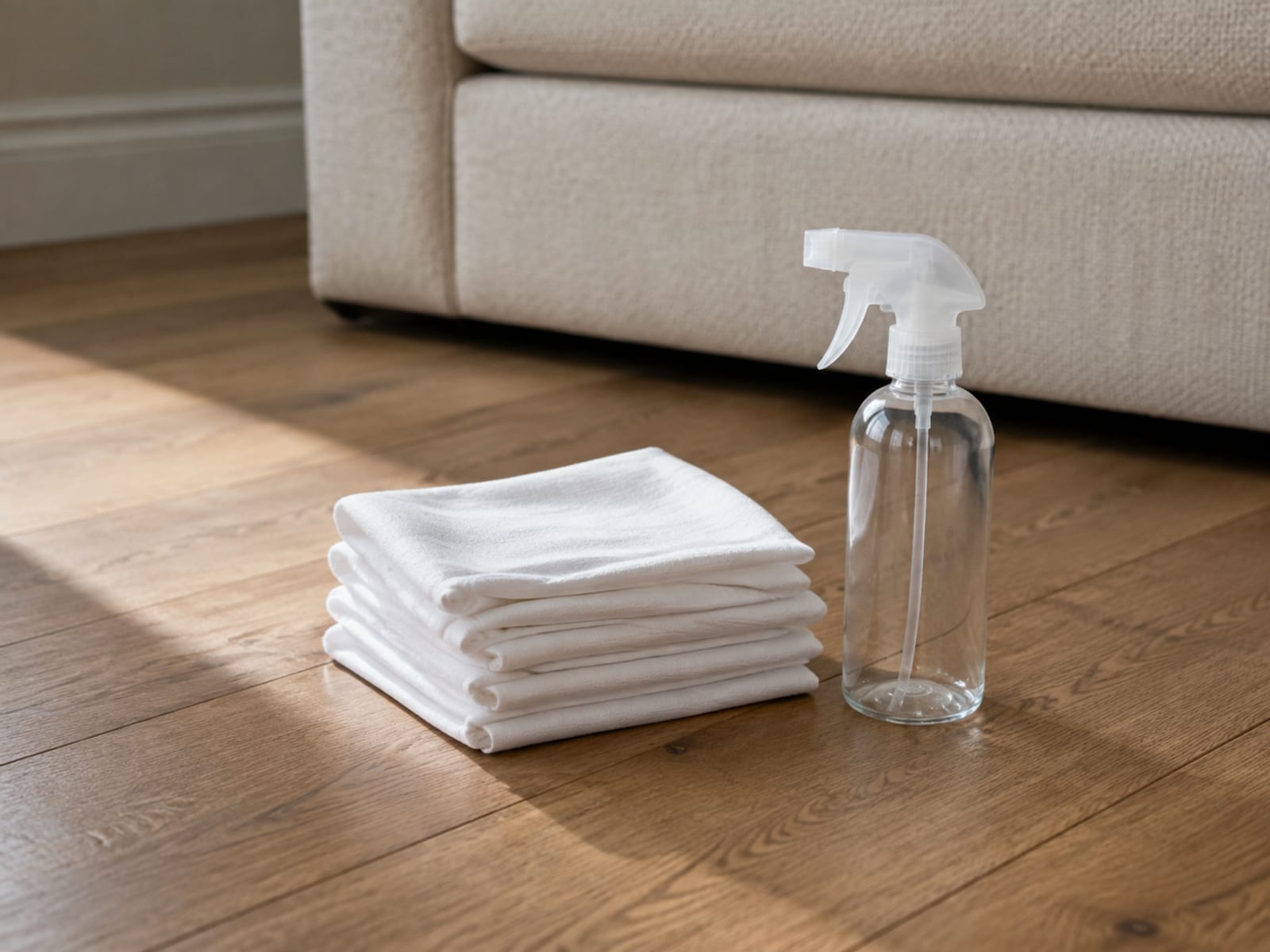
Press, do not scrub. Take a clean, absorbent white cloth, lay it on the spill and press down so the liquid comes up into the cloth, then move to a dry part of the cloth and do it again. Crate and Barrel's care instructions say to work from the outer edge toward the center, which keeps the spill from spreading outward into clean fabric while you are lifting it.
A white cloth matters more than it sounds. A colored towel pressed hard into a damp cover can move its own dye into the upholstery, and you will have replaced a coffee stain with a blue one.
Scrubbing drives the spill deeper toward the foam, where no amount of surface work will reach it, and it abrades the fibres in one small area so that patch reads differently in the light afterwards even once the stain is gone.
What you should not do in that first minute is reach for a bottle. Nothing goes on the fabric until you know the letter.
Where is the care tag, and what is on it?
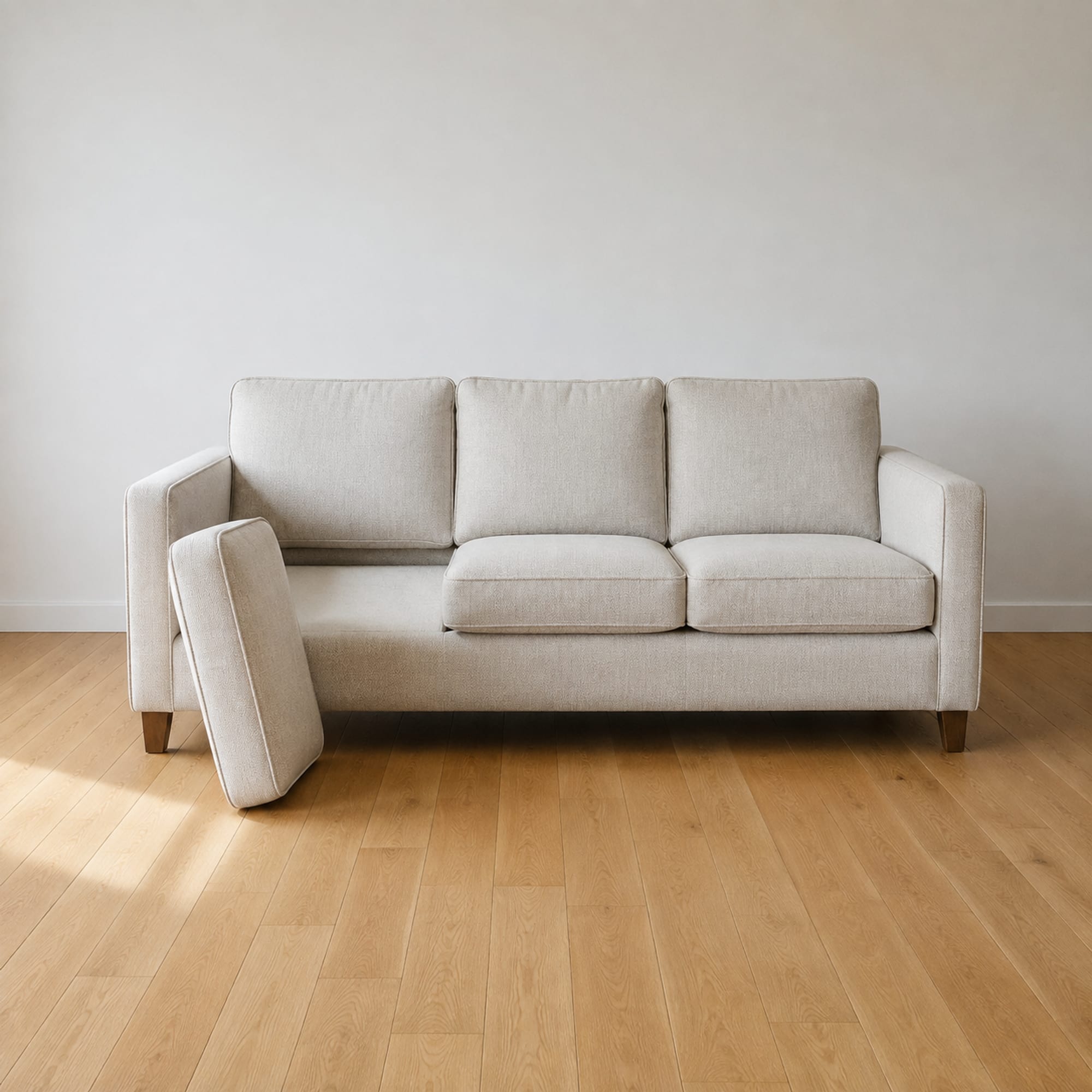
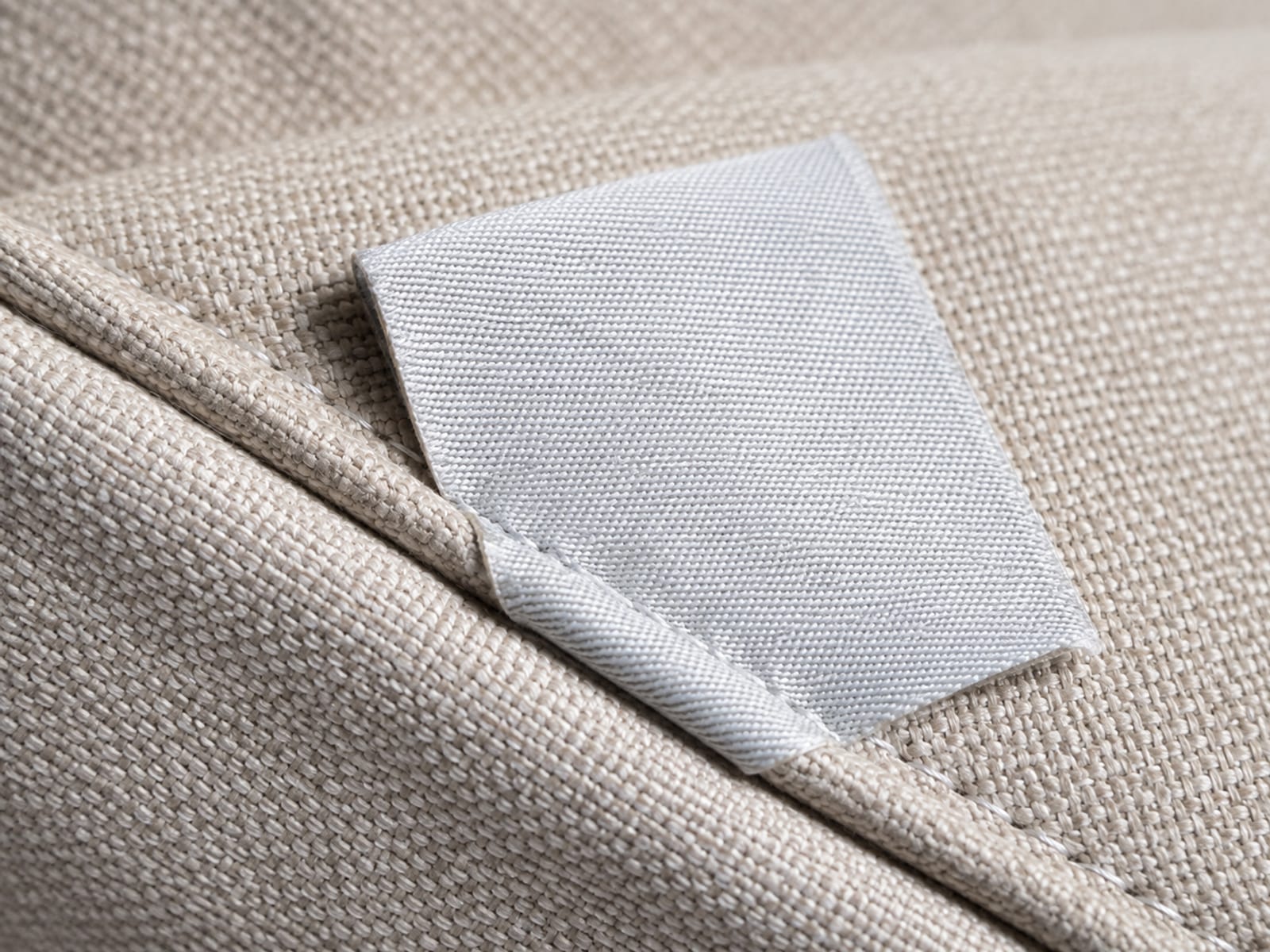
Look under the seat cushions first. Lift each one and check the underside of the cushion and the deck it sits on. If nothing is there, tip the sofa gently forward or lie down beside it and look at the underside of the frame, which is where Ashley says the tag commonly is on its own pieces.
Take a photograph of it while you are down there. You will want it again the next time something spills, and on a rental or a secondhand piece it is the only proof you have of what the cover will tolerate.
The tag carries a letter, and that letter is a cleaning permission rather than a quality score. A high-end wool and a budget microfiber can carry the same code, and an expensive cover is more likely to be restrictive rather than less.
If there is no tag at all, treat the couch as though it were coded S until somebody who can see the fabric tells you otherwise. A missing tag is the single most common reason a home attempt goes wrong, because water looks like the safe option right up until it is not.
What does your letter actually permit?
Ashley publishes the four definitions, and they are narrower than the way the codes get talked about online. S and WS in particular are not the same instruction: S rules water out, and WS allows either family. And the fiber name is no substitute for the letter: two velvets from the same maker carry different codes, and the all-polyester one is the one that takes water.
Hover or tap a row to highlight it.
| Code | What it permits | What it rules out |
|---|---|---|
| W | Water-based cleaning: upholstery shampoo, or foam from a mild detergent, without saturating the fabric | Water-free dry-cleaning solvents |
| S | A water-free dry-cleaning solvent only | Water, shampoo, detergent foam, and every home recipe made with water |
| WS | Either family: shampoo, detergent foam, or a dry-cleaning solvent | Saturation, whichever family you choose |
| X | Vacuuming, or a light brush | Every liquid cleaner, water-based and solvent alike |
X is the one that surprises people. It does not mean the fabric is delicate in a way you can work around with a gentle touch. It means no cleaning liquid at all belongs on it, and a stain on an X-coded cover is a job for somebody with the equipment to treat it without wetting it.
The baking soda and vinegar mixture that circulates in cleaning videos is not a method any of these makers publish, and it cannot make an S or an X cover safe to wet. Let the letter decide rather than the recipe.
How do you clean it by hand?
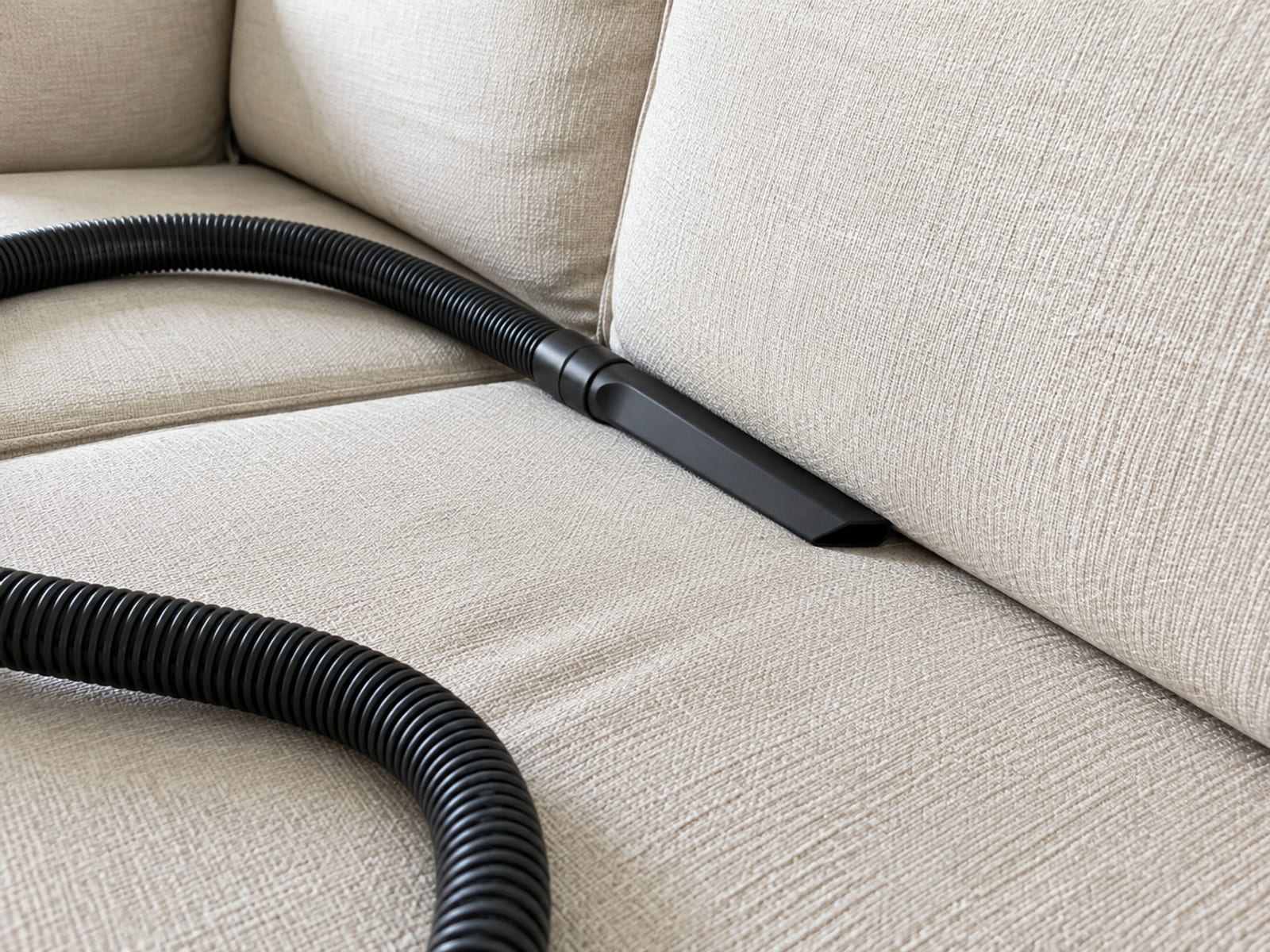
Vacuum first, every time. Use the upholstery tool on the surfaces and the crevice tool down the seams and under the cushions. Dry soil that is still sitting in the weave when liquid arrives turns into a stain of its own, spread over a wider area than the one you started with.
Then pre-test. Put a small amount of whatever your letter permits on a hidden patch, the back of the skirt, the underside of a cushion, the part of the arm that faces the wall, and let it dry fully before you judge it. Crate and Barrel asks for that inconspicuous test for a reason: colour change and shrinkage both show up after drying, not during.
When you clean, work the whole cushion face or the whole arm section rather than the spot itself. BISSELL's upholstery guide gives that instruction to avoid a water mark, and it is the difference between a couch that looks cleaned and a couch with a pale halo where the stain used to be. Use as little liquid as the label allows and keep it off the filling.
If your tag reads W or WS, a portable extractor does the part hands cannot: it pulls the loosened liquid back out instead of leaving it in the foam. BISSELL's own process is to fill to the marked lines, spray, brush gently, then pull the tool across with the spray switched off so the pass is suction only, repeating until most of the liquid has come back up. Before you buy one, check how far a portable machine's hose and cord actually reach, because that is what decides whether you clean a three-seat sofa from one position or three.
A machine is an option rather than a requirement, and it is the wrong purchase entirely if your tag reads S or X. The upholstery cleaners worth buying are sorted by that same letter, so the shortlist is already narrowed by the time you get there. On an X-coded cover in a household with a dog, the money goes further on a washable couch cover for dogs, because a layer you can put through a machine is the only cleaning that cover permits. On those covers it cannot be used at all, and the money is better spent on one visit from somebody who can treat the fabric dry.
How long does it need to dry?
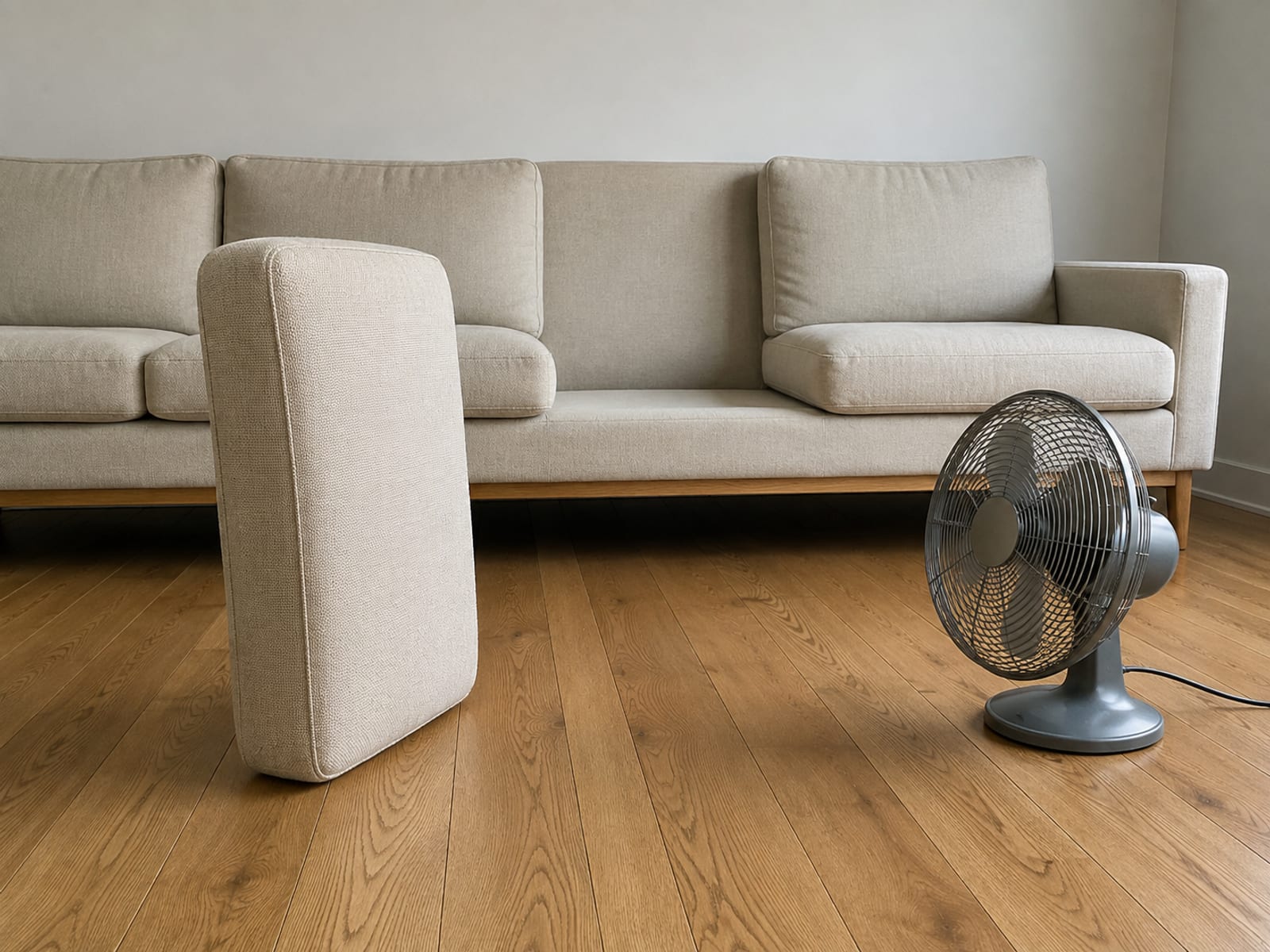
At least four to six hours after a water-based clean, which is the window BISSELL publishes for its own workflow. Point a fan at the cushion, open a window or run the air conditioning, and keep everyone off it until it is dry all the way through rather than dry to the touch.
Judging the result early is the mistake here. Upholstery looks darker and patchier while it is damp, and a cover that seems ruined at hour two is often fine at hour six. Wait before you decide whether a second pass is needed.
A cushion that is still cool and heavy underneath has liquid in the filling, and closing the room up on it is how a cleaning job turns into a smell. Give it longer than you think, and give it air.
When should you stop and call somebody?
Stop after one honest attempt that did not work. A second and third round of the same treatment rarely lifts what the first one left, and each pass puts more liquid into the piece.
Call a professional upholstery cleaner when the tag reads S or X and the stain is real, when there is no tag, when the cover is wool, silk, suede, velvet or anything you cannot identify, and note that a napped cover has its own method, since cleaning a microfiber couch turns on lifting the pile back up afterwards, when the spill has reached the filling, or when the problem is mould, smoke, ink or dye transfer. Pet urine is its own case, because it soaks past the cover rather than sitting on it, and getting pet urine out of a couch turns on treating the filling as a separate job from the cover. A smell with no visible mark is its own case too, since a couch that still smells after the cover is clean is usually holding it in the filling or the deck underneath. Zerorez says a cleaner checks the tag first and that delicate covers may need dry-cleaning or gentler methods, which is the same judgement you are making, with better equipment behind it.
Odour is its own problem rather than a harder version of this one. A smell that survives a clean is usually coming from the filling rather than the cover, and it is diagnosed and treated differently.
There is also a job that is not a cleaning job at all. Torn fabric, a failed seam, a broken spring or a frame that has gone soft needs an upholsterer, and no amount of cleaning repairs construction.
What does it cost to hand it over?
Published planning ranges rather than quotes, and they differ by scope. HomeGuide put upholstery cleaning at $100 to $400 for a sofa and $120 to $500 for a sectional as of September 2026, with a typical total visit landing between $100 and $250. Zerorez's Bay Area guide put a standard sofa at $100 to $250 and a sectional at $150 to $400 over the same period.
Both are estimates made before anyone has seen your couch. The figure that counts is a written quote from a local cleaner after it has looked at the fabric and the code, and getting one costs nothing.
If the cover has reached that point, what to check on the next sofa before you buy it starts with the care instructions for that exact cover rather than with the fibre's reputation.
Repair sits in a different band again. HomeGuide put couch repair at $250 to $1,000 and reupholstering a couch at $600 to $2,000 as of September 2026, which is worth knowing before you spend an afternoon trying to rescue a cover that has reached the end of its life.
Set against buying a machine you would use a few times a year, one professional visit on a difficult fabric is usually the better spend, and on an S or X cover it is the only option that is not a risk.
Would you know what to do tonight?
1. You spill red wine and grab the nearest towel, which is navy blue. What is the risk you have just added?
2. The tag under your seat cushion reads X and there is a coffee ring on the arm. What may you use on it?
3. You have cleaned a W-coded cushion with a water-based foam and it looks blotchy after twenty minutes. What should you do?
4. Your tag reads S. What does that rule out?
Pick an answer to begin.
Frequently asked questions
Can I use Dawn dish soap to clean my fabric couch?
Only if your tag reads W or WS, because both of those permit foam from a mild detergent. Ashley's own direction is to use the foam rather than the liquid and not to saturate the fabric. On an S or X cover it is ruled out completely, whatever the bottle is.
What are the most common fabric couch cleaning mistakes?
Rubbing instead of blotting, putting liquid on before vacuuming the dry soil out, skipping the hidden-patch test, treating the stain rather than the whole cushion face, and sitting down before the fabric has dried through. Using water on an S or X cover is the one that cannot be undone.
Is it better to shampoo or steam clean a couch?
Neither is better in general, because your tag decides which is available. W and WS covers can take a water-based workflow, S needs a water-free solvent, and X takes neither. Professional cost guides treat steam cleaning, chemical cleaning and stain treatment as separate services rather than competing choices.
How often should a fabric couch be cleaned?
BISSELL suggests vacuuming weekly or every other week and a deeper clean roughly every two months for covers it can be used on. Crate and Barrel asks for slipcovers to be brushed or vacuumed at least monthly with a cleaning once a year. Both are maker guidance rather than a standard, and your own tag still governs what the deeper clean can involve.
The words on a cleaning label
Tap a term to see what it means.
Blot. To press an absorbent cloth into a spill so the liquid lifts into it, working from the outer edge toward the middle. The opposite of scrubbing, and the only safe first move on any code.
For the rhythm the rest of the year runs on, three intervals cover a couch and only one of them is weekly.
If a previous attempt has already left a ring or a patch, the mistakes that make a mark bigger is the sequence to read before you try again.
Once it is clean and fully dry is the only moment a protector is worth applying, because a spray seals in whatever is under it and the coverage figure on the can decides how many you need.
Photograph the tag before you put the cushion back, and keep the letter in your phone with the rest of the details about the sofa, because the next spill will not wait while you go hunting for it a second time. If it turns out to read X, or the cover has already taken more than it can take, the fabric itself is the thing to change on the next sofa rather than the cleaning method, and PlushPick compares the sofa fabrics whose covers come off and go in a machine.
Cal Hewitt
Writer at PlushPick. I compare sofa specs, comfort, durability, and value so you can buy with clearer expectations.
About Cal and how the guides are researchedThe latest
 "Best-of"Best Furniture Protectors for Pets, by What They Actually Cover
 "Best-of"Best Pet-Friendly Sofa Fabrics: Claws, Hair and Spills
 "Best-of"Best Sofas for Small Spaces: Narrow Doesn't Mean Shallow
 "Best-of"Best Recliner Covers for Dogs: What Actually Stays On
 AnswerSofa vs Sectional: Which One Fits Your Room and Life
 AnswerHow to Measure a Sofa So It Fits Through the Door