

Affiliate disclosure. If you buy through a link on this page, PlushPick may earn a commission at no extra cost to you. That never changes which products are named or what is said about them. As an Amazon Associate I earn from qualifying purchases. How this works
There is no single interval, and that is why the number you keep reading feels unsatisfying. There are three jobs on a couch and they run on different clocks. Vacuum it weekly, which is what the EPA publishes for carpets and furniture, using a HEPA-filter vacuum on fabric-covered pieces. Deal with a spill immediately, blotting from the outside of the mark toward the middle. And book a professional clean of the whole piece about once a year, which is Crate & Barrel's own care recommendation and which it describes as variable by use. Those are three answers to three different questions, and only the first one is weekly.
Key Takeaways
Weekly is the vacuum, not the deep clean
The EPA says to vacuum carpets and furniture every week, and to use a HEPA-filter vacuum on fabric-covered furniture.
Wait 20 to 30 minutes before going back in
The AAFA publishes that gap after vacuuming, and almost nobody mentions it.
Immediately is its own interval
A spill is not on a schedule. Blot from the outside inward and follow the code on the tag.
The annual figure is a furniture maker's suggestion
Crate & Barrel recommends periodic professional cleaning and says annually, adjusted by how the sofa is used.
Vacuuming does not get everything
The AAFA says mites and their debris live deep in sofa stuffing, so a weekly vacuum is a reduction rather than a removal.
Somebody with asthma should not be the one vacuuming
The EPA says a person with asthma or allergies should leave the area being vacuumed.
The weekly job, and who says so
Every week, with a vacuum. That is the interval with the most disinterested source behind it: the EPA's own asthma guidance says to vacuum carpets and furniture every week and recommends a HEPA-filter vacuum on fabric-covered furniture. The AAFA publishes the same weekly HEPA cadence.
Neither of those organizations sells a cleaning service, which is worth noting only because it explains why their number is different in kind from the one that appears everywhere else. They are describing indoor air, not upholstery appearance.
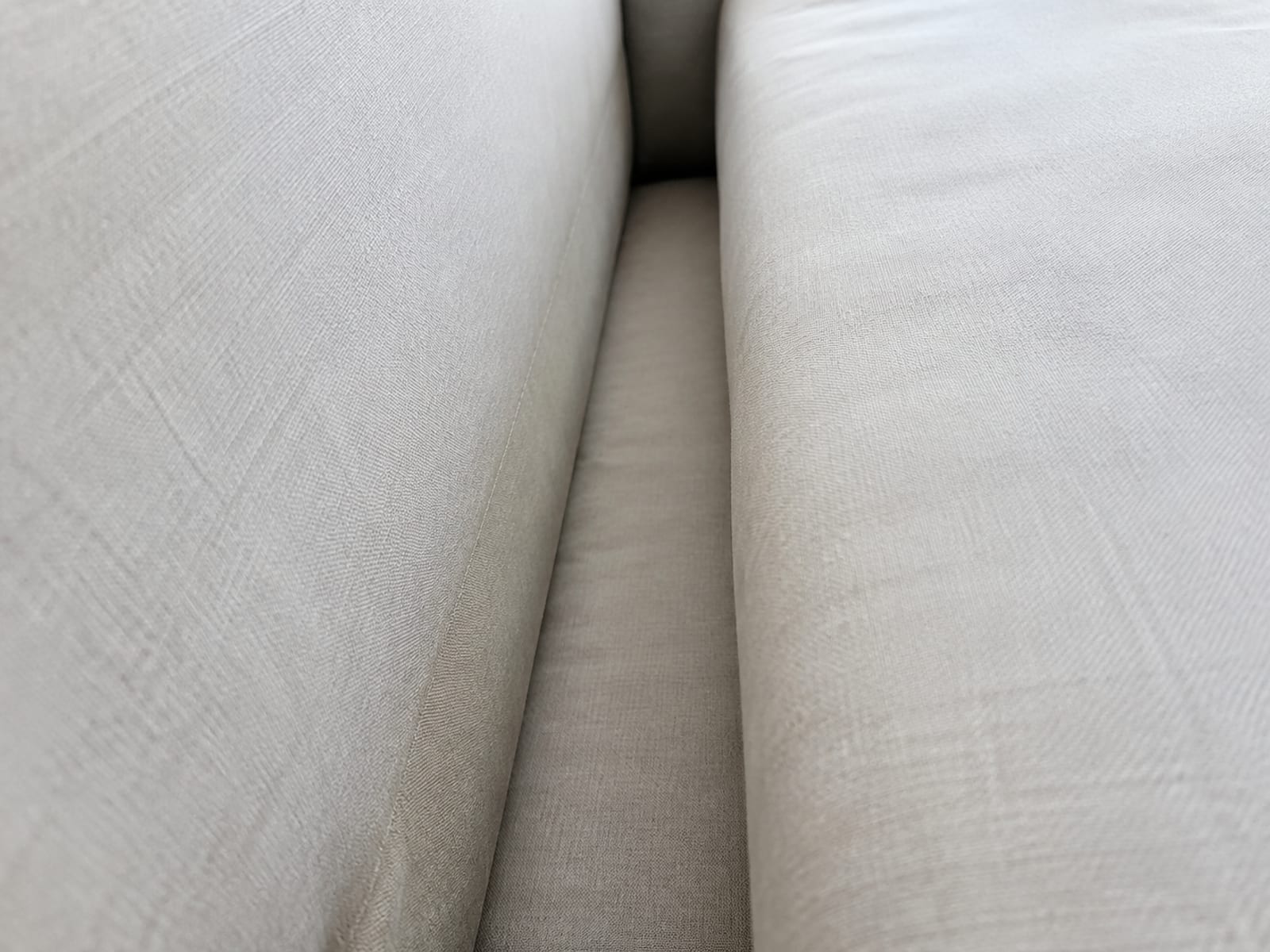
What the weekly pass covers is the whole surface plus the parts nobody does: the seams, the crevice between the seat and the back, and underneath the loose cushions rather than just over them. An upholstery tool for the flat faces and a crevice tool for the joins is the whole kit.
The EPA adds something that rarely travels with the weekly advice: a person with asthma or allergies should leave the area being vacuumed, and the AAFA says to wait 20 to 30 minutes after cleaning before going back into a room that has been dusted or vacuumed. That gap exists because vacuuming lifts material into the air before it settles, so the room is briefly worse rather than better.
Three clocks, three jobs
- 1
Weekly
Vacuum the surface, the seams, the crevices and under the loose cushions. HEPA filter on fabric-covered furniture, per the EPA.
- 2
After vacuuming
Leave the room 20 to 30 minutes before going back in, per the AAFA.
- 3
The moment something spills
Blot from the outside of the mark toward the middle. Never rub, and check the code before any product goes near it.
- 4
About once a year
A professional clean of the whole piece, which Crate & Barrel recommends and describes as variable by use.
- 5
Adjust upward for
Heavy daily use, animals on the furniture, eating on the sofa, or anyone in the house with a respiratory condition.
The immediate job, which has no schedule at all
A spill is the one that cannot wait for a rhythm, and the instruction is short. Blot with a clean cloth from the outside of the mark toward its middle, which is what Crate & Barrel's care instructions specify, and do not rub.
Before any product goes anywhere near it, find the tag. Ashley's care page says it is under a seat cushion or under the unit itself, which saves five minutes of looking. The letter on it decides what is permitted, and what each letter permits is the whole method.
The reason this belongs in a piece about frequency is that most of what people eventually pay a professional to fix started as a spill that waited. Speed here reduces how often the annual job has to be a rescue rather than maintenance.
The annual job, and where that number comes from
Once a year, roughly, for a professional clean of the whole piece. That figure traces to one place: Crate & Barrel's published care instructions recommend professional upholstery cleaning periodically, suggest annually, and say it varies by use. That is a furniture manufacturer's care recommendation, not a standard and not a test result. Most of the pages you will find quoting once or twice a year are run by companies that carry out professional cleaning, and their figure happens to match the furniture maker's, which is a reasonable position for all of them to hold.
What "variable by use" means in practice is the part worth acting on. A sofa in a spare room used at Christmas is not on the same schedule as one that takes a family, a dog and dinner every evening. Adjust upward for daily heavy use, animals allowed on the furniture, eating on it, or anyone in the house with a respiratory condition. Adjust downward for a piece that is barely sat on.
The professional standard covering this work is ANSI/IICRC S300, listed in the IICRC's standards index as the Standard for Professional Upholstery Cleaning, and asking a company whether it works to it is a fair question when you book.
What a weekly vacuum does not do
The weekly vacuum has a real limit and it is worth knowing where it stops.
The AAFA says that mites and their debris live deep in sofa stuffing, which means vacuuming does not remove all of them. A weekly pass reduces what is on and near the surface; it does not reach what has worked its way down into the fill. The AAFA also puts the indoor relative humidity target at 30 to 50 percent, which is a different lever entirely and one a vacuum cannot pull.
None of that makes the weekly vacuum less worth doing. It makes it the floor rather than the whole answer, and it is the reason the annual deeper clean exists at all. If allergies are the actual reason you are asking, the layer a smell or an allergen is actually sitting in goes further into it than a schedule can.
What changes your interval, and what does not
Use changes it. Household changes it. The sofa's own specifications do not.
Turn the cadence up for daily use by several people, for animals that sit on the furniture, for eating on the sofa, and for a house with asthma or allergies in it. Turn it down for a formal room nobody uses. Those are the variables Crate & Barrel's "variable by use" is pointing at.
What does not change it: the width of the sofa, its seat depth, what it cost, or where the television is. Those are buying and layout decisions and none of the published cadences here is tied to any of them. A bigger sofa takes longer to vacuum; it does not need vacuuming more often.
The one specification that genuinely matters is the care code, and it changes the METHOD rather than the frequency. An X-coded cover still wants its weekly vacuum; it just never wants anything wet.
Hover or tap a row to highlight it.
| Job | Interval | Published by |
|---|---|---|
| Vacuum the whole piece | Weekly | The EPA, and the AAFA for the HEPA part |
| Leave the room afterward | 20 to 30 minutes | The AAFA |
| Blot a spill | Immediately | Furniture makers' own care instructions |
| Professional whole-piece clean | About annually, variable by use | Crate & Barrel's care instructions |
| Indoor relative humidity | 30 to 50 percent | The AAFA |
When the answer is that it has gone too far
Sometimes the honest answer to how often is that the schedule stopped being the issue. A poster on r/CleaningTips describing an uncleanable couch is past a cadence question and into a repair-or-replace one.
The signals are consistent: a smell that comes back after the piece has fully dried, marks that have grown after previous attempts rather than shrunk, or a cover whose code rules out everything you own. At that point a professional inspection tells you more than another weekend will, and it is cheaper than guessing.
Would you get this one right?
1. The EPA publishes a vacuuming interval for carpets and furniture. What is it?
2. The AAFA publishes a wait after vacuuming before re-entering the room. How long?
3. Where does the "once a year" professional cleaning figure come from?
4. Which of these changes how often a couch needs cleaning?
Pick an answer to begin.
Frequently asked questions
How often should you deep clean a couch?
About once a year for a professional clean of the whole piece, which is Crate & Barrel's own care recommendation, adjusted upward for heavy daily use, animals on the furniture, or a household with allergies. That figure is a manufacturer's suggestion rather than a standard, and the maker itself says it varies by use.
Is it worth cleaning a couch?
The weekly vacuum is worth it on air-quality grounds alone, which is why the EPA and the AAFA both publish a weekly cadence for furniture. The annual professional clean is worth it when the piece gets real use, and it is worth much more if spills have been blotted promptly rather than left to set.
How often should I vacuum my couch?
Every week, per the EPA, with a HEPA-filter vacuum on fabric-covered furniture. Cover the seams, the crevices and under the loose cushions rather than just the visible faces, and leave the room for 20 to 30 minutes afterward as the AAFA advises.
Does a weekly vacuum get rid of dust mites?
No, and the AAFA is explicit that mites and their debris live deep in sofa stuffing where vacuuming does not reach them. The weekly pass reduces what is near the surface. Humidity is the other lever, with the AAFA's target at 30 to 50 percent.
Does the size of my sofa change how often I should clean it?
No. Dimensions, seat depth, price and room layout are buying decisions and have no bearing on cleaning frequency. Use and household do. The one specification that matters is the care code, and it changes what you may use rather than how often you should.
The terms behind the intervals
Tap a term to see what it means.
HEPA filter. A filter fine enough to hold what an ordinary vacuum can pass back into the room. The EPA recommends one specifically for fabric-covered furniture.
Put the weekly vacuum somewhere it will actually happen, because it is the one interval on this list with a health agency behind it and the one most people skip entirely. And if the reason you went looking was a mark rather than a schedule, PlushPick has the mistakes that make a mark bigger before you try anything else on it.
Cal Hewitt
Writer at PlushPick. I compare sofa specs, comfort, durability, and value so you can buy with clearer expectations.
About Cal and how the guides are researchedThe latest
 "Best-of"Best Furniture Protectors for Pets, by What They Actually Cover
 "Best-of"Best Pet-Friendly Sofa Fabrics: Claws, Hair and Spills
 "Best-of"Best Sofas for Small Spaces: Narrow Doesn't Mean Shallow
 "Best-of"Best Recliner Covers for Dogs: What Actually Stays On
 AnswerSofa vs Sectional: Which One Fits Your Room and Life
 AnswerHow to Measure a Sofa So It Fits Through the Door