


Affiliate disclosure. If you buy through a link on this page, PlushPick may earn a commission at no extra cost to you. That never changes which products are named or what is said about them. As an Amazon Associate I earn from qualifying purchases. How this works
Press dry white towels into the wet patch and keep pressing until they stop taking anything up. Do not rub. Then, before a single drop of cleaner goes anywhere near the fabric, go and read the care tag and work out what your couch is actually made of, because the label on the bottle you were about to open probably rules out several materials on its own. After that the job splits in two, and it stays split: the cover is one problem and the padding underneath it is a different one, which is why so many people wash a cover and find the smell waiting for them a week later.
Key Takeaways
Pressure first, and no scrubbing
Press a dry white towel into the whole wet area and swap it as it loads. PetMD says rubbing can spread the urine through the fabric instead of lifting it.
The wet area is bigger than the mark
No care instruction gives a treatment margin in inches, so work the wet patch you can actually feel rather than the stain you can see.
The bottle has its own exclusion list
Nature's Miracle tells you not to use it on untreated hardwood, leather, suede, silk or wool specialty fabrics, and your sofa's tag rules out more.
A washed cover is not a clean cushion
IKEA lists the cover and the foam as separate components with separate care. One went in the machine; the other did not.
Enzyme cleaner goes on full strength, not diluted
That is the direction on the label, along with a five minute test on a hidden patch before any of it touches the visible fabric.
Odor that returns under pressure is odor you did not reach
If it only appears when you press the cushion, the liquid is deeper than a surface treatment goes.
What should you do in the first ten minutes?
Take dry white towels, lay one over the wet area, and press down hard enough that the liquid comes up into the towel. When the towel stops lifting anything, swap it for a fresh one and press again. Keep going until a dry towel comes away dry. PetMD's guidance, written by Tiffany Tupler, DVM and reviewed by Jo Cornett, DVM, is specific about the part people get wrong: rubbing or wiping spreads urine through the fabric rather than removing it.
Use white towels for the same reason you would use a white cloth on any spill. A colored towel pressed hard into damp upholstery can leave its own dye behind, and a blue patch is not an improvement on a yellow one.
Work the area that is genuinely wet, not the area that looks marked. Press with your hand and find where the damp actually stops, then treat all of that. Chasing a fixed margin in inches around the stain is guesswork; your palm tells you where the edge is, and the edge is rarely where the discoloration ends. If the padding under the cover feels wet, that is part of the wet area too, and putting a dry towel over it does not make it dry.
What is the couch made of, and what does that rule out?
This is the question the quick answers skip, and it decides everything that follows. PetMD's instruction is to use a cleaner the couch maker permits for that fabric, which means the care tag governs before any product does. The tag is usually under a seat cushion or on the underside of the frame, and the letter printed on it is the thing to find and photograph while you are down there. What each of W, S, WS and X actually permits is set out in the full method for cleaning a fabric couch by hand, and it is worth two minutes now rather than a bleached patch later.
The bottle has an opinion too, and it is easy to check. The directions for Nature's Miracle Advanced Stain and Odor Eliminator, reproduced on its Petco listing, say not to use it on untreated hardwood, leather, suede, silk or wool specialty fabrics. So, if your couch is leather or suede, the most recommended product for this job is already out, and the ordinary advice you have been reading was never written for your sofa. Those materials need their own treatment, and cleaning a leather couch starts by working out which leather it is rather than by adapting this one.
Where the tag permits nothing wet at all, the whole water based sequence below is unavailable, and that is worth knowing before you have soaked a cushion rather than after. Every widely repeated method for urine, the sprays, the solutions, the enzyme products, involves putting liquid into the fabric. On a cover that does not allow liquid, the next step is a professional rather than a smaller amount of the wrong thing.
Is the cover removable, and does that finish the job?
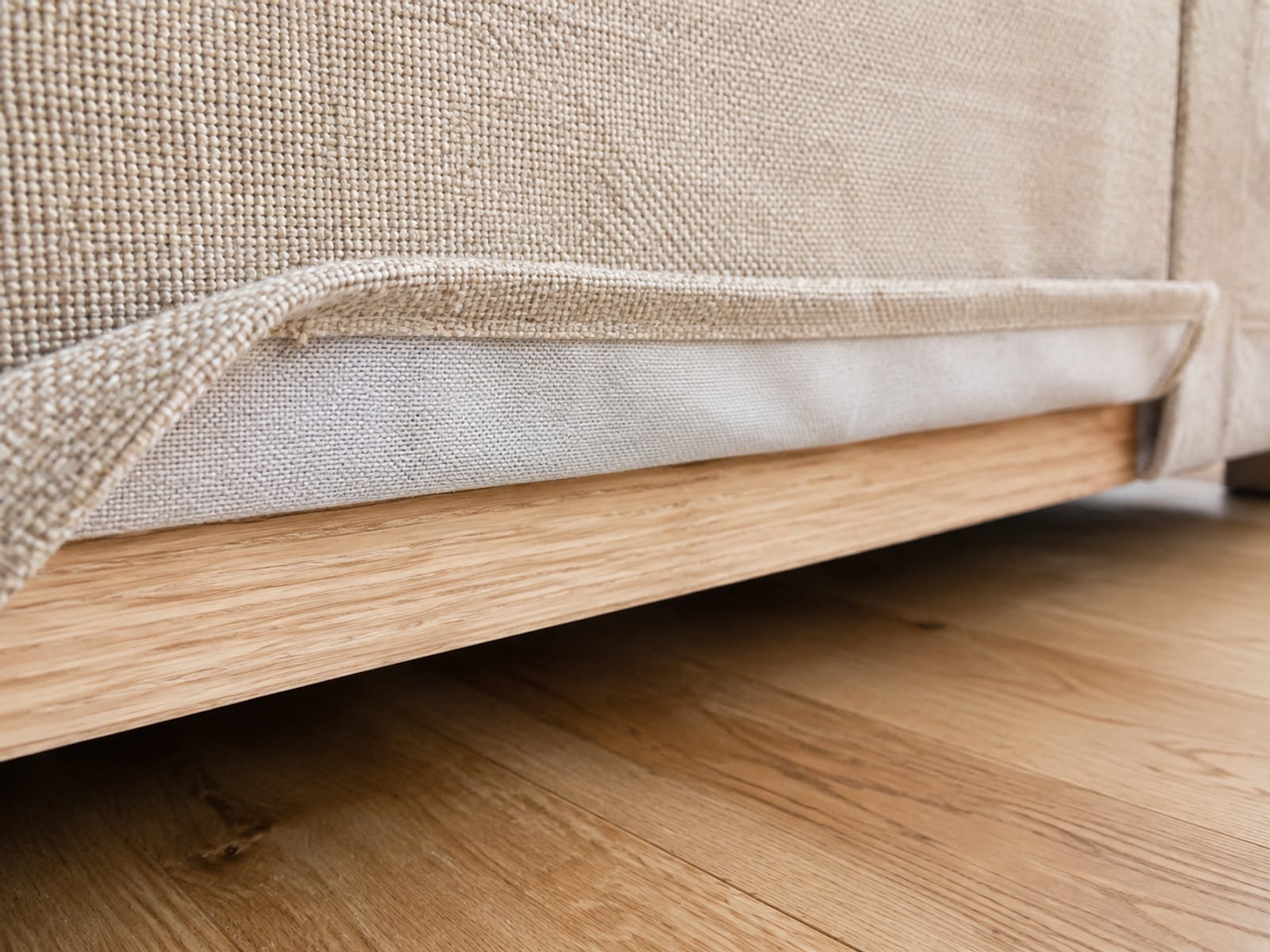
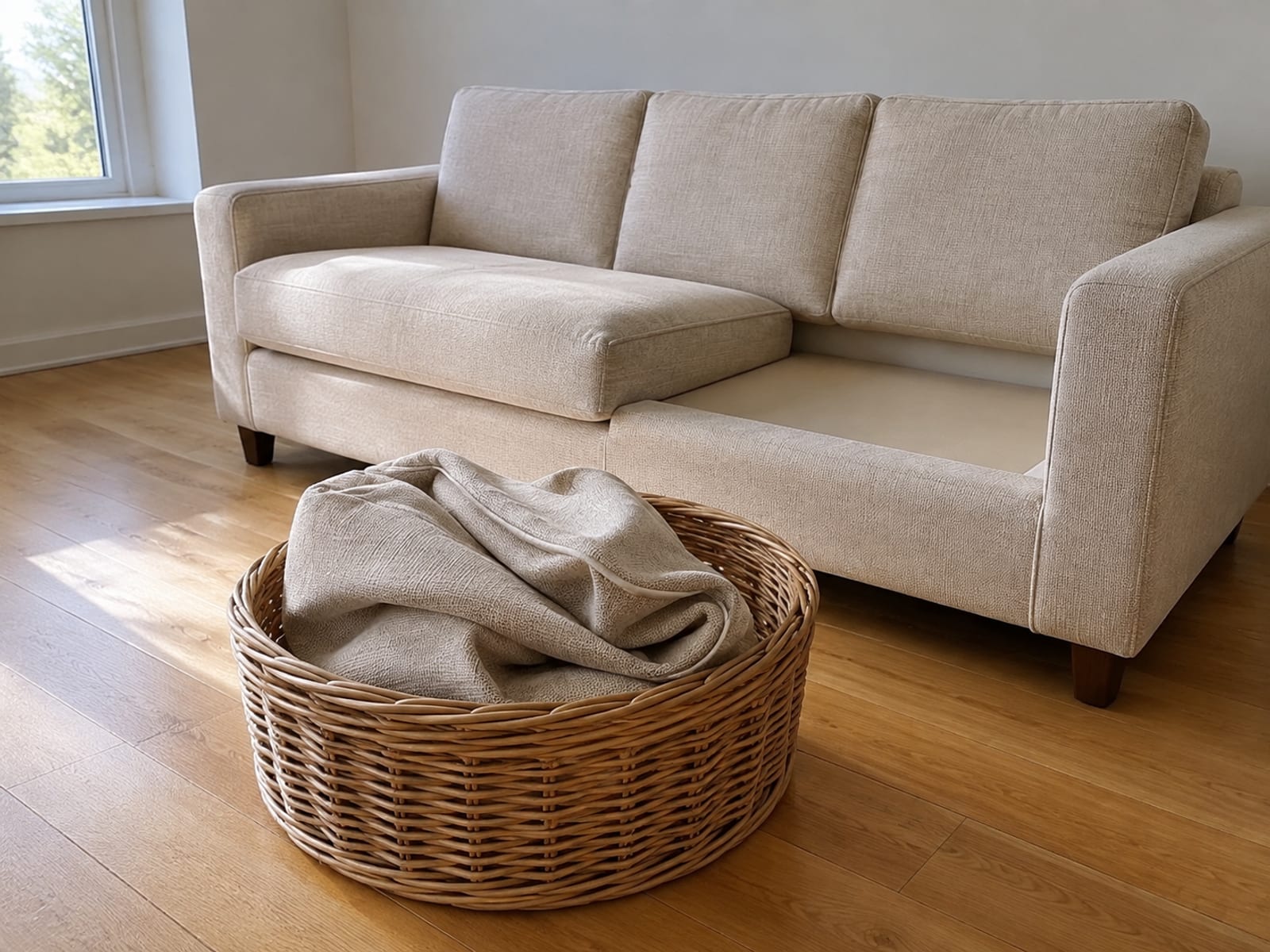
Not by itself, and this is the part worth slowing down for. A removable cover and the filling inside the cushion are two different components with two different care instructions, and the manufacturers say so plainly. IKEA's KIVIK sofa page lists a machine washable cover, and then gives the frame a completely separate instruction: a damp cloth with a mild cleaner, wiped dry. Inside that same cushion is high resilience polyurethane foam at 2.2 pounds per cubic foot, a second polyurethane foam at 2.0 pounds per cubic foot, and a steel pocket spring unit. None of that goes in a washing machine.
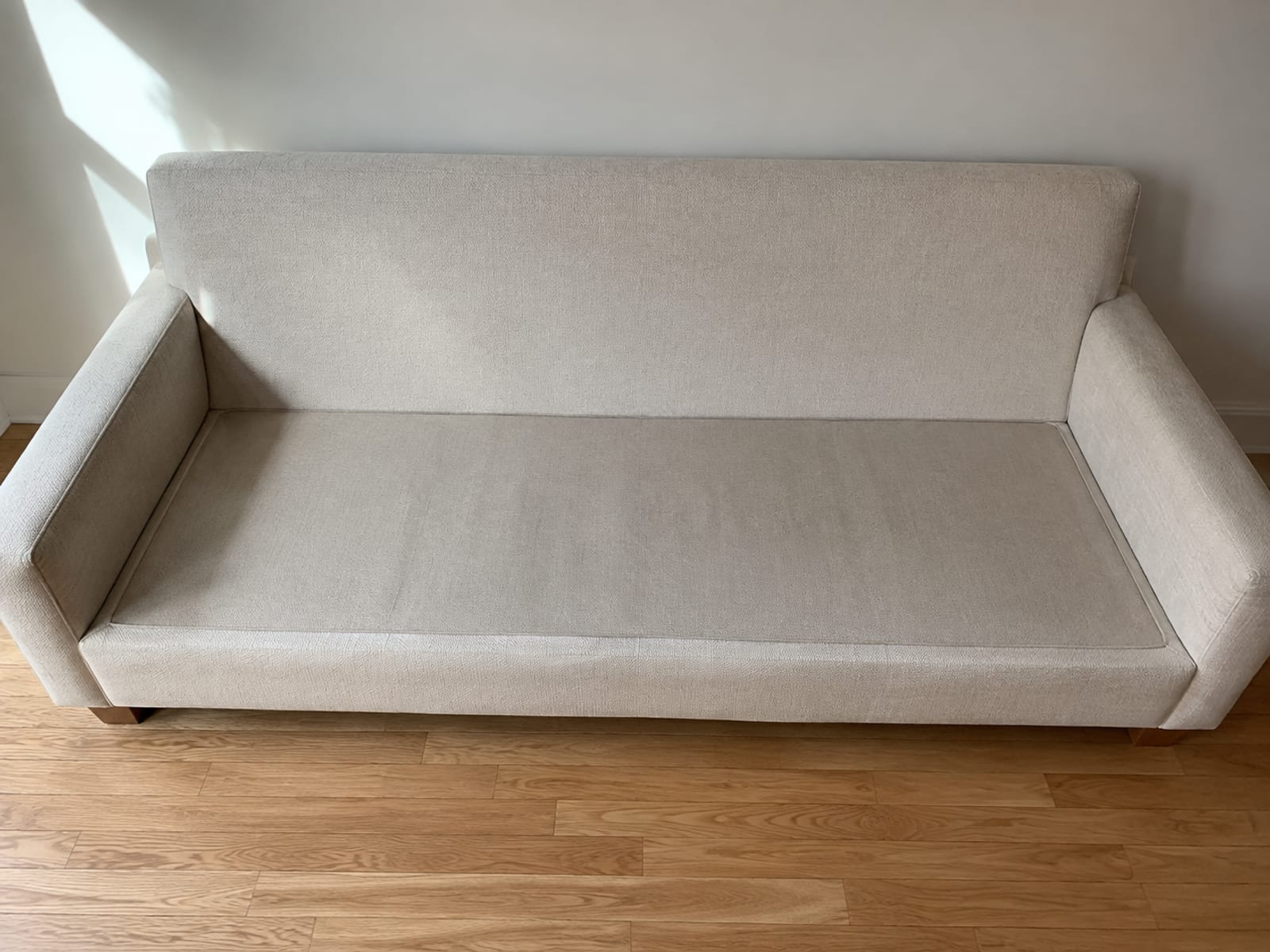
So, the cover coming off is good news about the cover, and it tells you nothing about what soaked past it. Somebody on r/CleaningTips bought a couch from a person who fosters dogs, washed the seat covers three times, and reported afterward that the covers smelled fine while the foam still seemed to need replacing. That is one person's experience rather than evidence about any product, but it is the exact shape of the problem: three washes of the wrong component.
Wash a cover only if that particular cover's own label permits it. Removable does not automatically mean washable, and a cover that shrinks in a machine will not go back on the cushion it came off.
How do you use an enzyme cleaner without wrecking the fabric?
Test it first, on a patch nobody will ever look at. The manufacturer direction for Nature's Miracle is to apply it to a concealed area, wait five minutes, then wipe with a white cloth. If color comes off onto the cloth, that product does not go on that sofa. Five minutes and an out of sight corner is a small price against a bleached patch you cannot reverse.
Then use it at full strength. The label says to use the product undiluted, which catches people out because the instinct with a strong cleaner is to water it down and be gentle with it. The reason it is not diluted is how it is meant to work: the Petco listing describes a bacteria based formula that produces enzymes when it meets a food source, and says it keeps working for as long as bio based mess is present. Diluting it is not a gentler version of the treatment, it is a weaker one.
Put it on before anything else, not after. The same directions warn that other cleaners and detergents can chemically set a stain, so an enzyme cleaner is a poor thing to reach for third, once a spot has already had two other products on it. If you have a bottle of it, it goes on early.
For a couch whose cover does not come off, PetMD gives a sequence worth following closely: leave a towel soaked in a hydrogen peroxide based cleaner on the wet spot for fifteen minutes, blot it dry, then apply an enzymatic cleaner and lift it with a clean towel. That fifteen minutes belongs to the peroxide step and to that step only. It is not a general dwell time for enzyme products, and PetMD says to follow the product's own instructions where they prescribe something different. Read the bottle rather than borrowing a number from a different bottle.
The 32 fluid ounce size was $13.57 at Chewy and $11.69 at Petco as of September 2026, which is roughly the cost of two coffees against a couch that cost several hundred dollars. It is also sold on Amazon. What you are buying is a product whose directions match your fabric, so if you would rather see the field sorted that way first, the upholstery cleaners compared by the care code they suit covers the machines as well as the bottles.
What if you did not find it until days later?
The order of operations does not change, but your expectations should. Liquid that sat for a week has had a week to move, and the thing it moved into may not be anything you can reach.
There is a useful account of this on r/CleaningTips from somebody whose dog had repeatedly urinated on the polyester corduroy back panel of a couch, where it sat for about a week before it was dealt with. That panel had no cushion and no filling, just fabric stretched over a wooden frame. They used an enzyme cleaner and a BISSELL machine repeatedly, and the odor stayed. Another user's read was that it had likely soaked into the frame itself, and suggested trying a professional before giving up on the couch.
What that account is useful for is the decision rather than the products in it. When a compatible treatment has been applied properly and the smell is still there, running the same treatment a fourth time is not the next step. Something under the fabric is holding the odor, and more of the same product cannot reach it.
Why does the smell keep coming back?
Because it was never fully removed, and the manufacturers are quite direct about that. Where there was no accident at all and the couch simply smells, the layer holding it is the thing to find first, because the treatment changes with the source. Nature's Miracle's own directions say complete elimination happens only when every odor source has been reached. A treatment that reached eighty percent of the urine has not solved eighty percent of the problem; it has left a source in place that will announce itself again on the first warm day.
There is a simple test for where it is hiding. If the room smells fine until somebody sits down, and then it does not, the liquid is in the cushion filling or in the frame rather than on the surface. Compression is pushing air out through material that still holds urine. That is a different job from the one you have been doing, and it is where a portable extractor earns its place, because it pulls liquid back out rather than adding more.
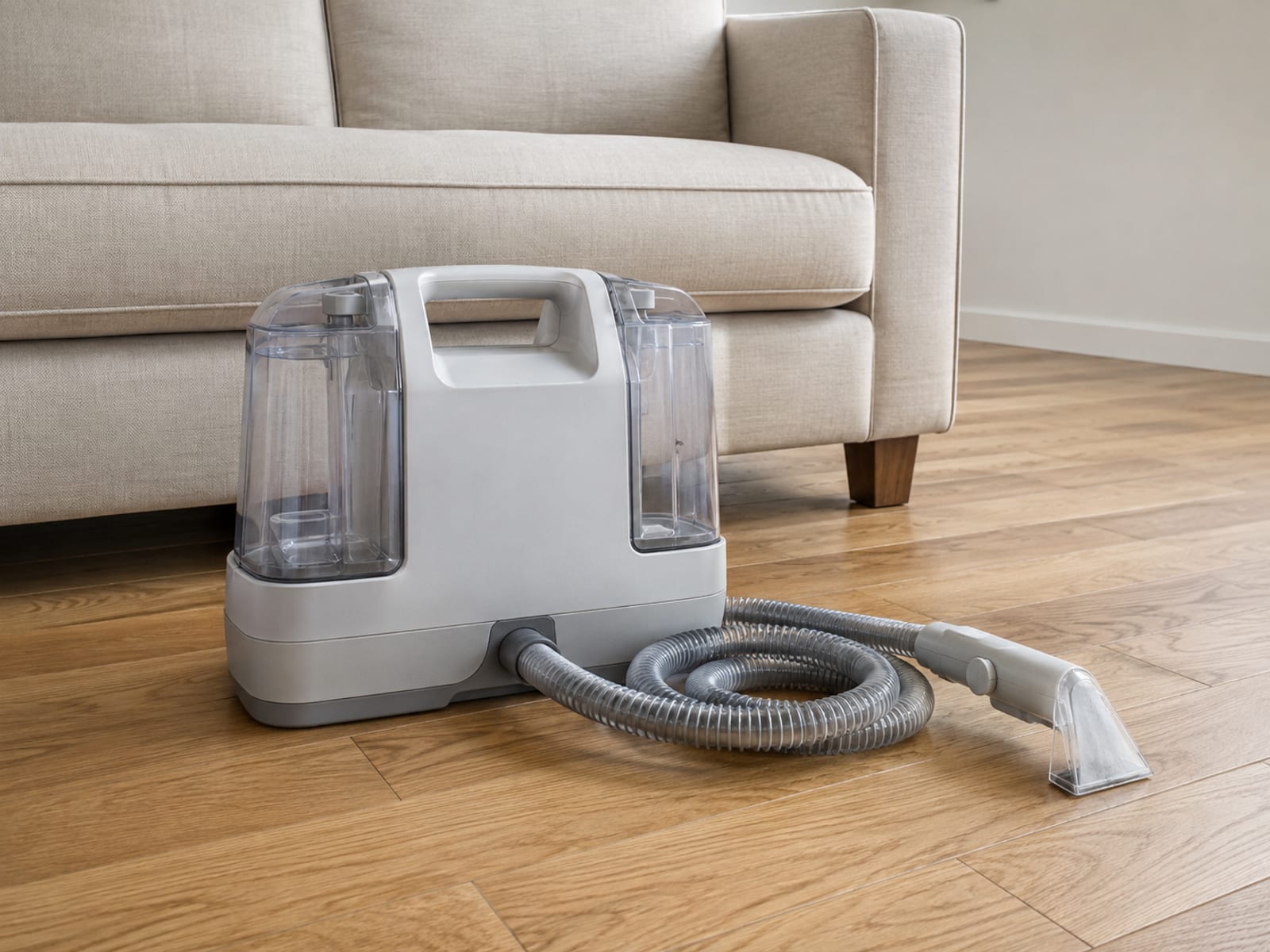
An extractor only belongs on a cover whose care instruction permits water based cleaning, and it is not a way around a tag that forbids liquid. Keep the cushion out of use until it is genuinely dry, and give it longer than you think. Drying time moves with the product, the room and how much liquid went in, so judge it by pressing a dry cloth into the foam rather than by the clock. Putting a cover back over damp foam, or sleeping on it, is how a solved problem becomes a recurring one.
When is it time to stop and pay somebody?
When the odor survives a treatment that was compatible with the fabric and correctly applied. When the urine has reached foam or a frame you cannot get at. When the material is leather, suede, silk, wool or anything else the cleaner's own label excludes. And when the only way to reach the liquid would be to put in more liquid than you can pull back out. PetMD's instruction at that point is to contact a professional cleaning service rather than keep layering products.
The trade has its own standard for this work, the ANSI/IICRC S300 Standard for Professional Upholstery Cleaning, which the IICRC lists among its accredited standards. The text itself is paid, so treat it as a thing to ask a cleaner about rather than a procedure to follow at home.
Hover or tap a row to highlight it.
| Option | Reported price | What it covers |
|---|---|---|
| Enzyme cleaner, 32 fl oz | $11.69 to $13.57 | Nature's Miracle at Petco and Chewy respectively |
| DIY machine rental | $30 to $60 per day | Angi's figure, cleaning solutions a further $10 to $20 |
| Professional, per piece | $120 to $232 typical | Angi reports a $174 average, updated July 2026 |
| Professional, whole sofa | $120 to $400 | Odor removal is a separate add on at $15 to $35 |
| Professional, sectional | $200 to $500 | More seating, more surface, more hours |
| Replacing it instead | $349 to $1,399 | IKEA KLIPPAN loveseat, KIVIK sofa, KIVIK chaise sectional |
Those figures come from Angi's upholstery cleaning cost guide and IKEA's own product pages for the KLIPPAN loveseat, the KIVIK sofa and the KIVIK sectional. Laid out together they answer the question people are really asking at eleven at night, which is whether this couch is worth saving. A professional visit costs a fraction of replacing a sofa, and it is the cheaper experiment by a wide margin. Get a written quote for your actual piece; a national range is a sanity check, not a price.
If you rent, take photographs before anyone treats anything, and get a quote before authorizing work. What a lease actually requires varies by agreement and by state, and that is a conversation to have with a document in front of you.
What if this is not the first accident?
Then the couch may be the smaller problem. PetMD notes that a dog who was reliably house trained and has started having accidents should see a veterinarian, because there can be a medical cause behind it. Cleaning the cushion perfectly does not help much if the same thing happens on Thursday, and a housebreaking puppy and a six year old dog who has never done this before are two entirely different situations.
Keep the cleaner where the animal cannot get to it, and use and store it as the label directs. If a pet does get into it, the ASPCA Animal Poison Control Center takes calls around the clock on (888) 426-4435, and a consultation fee may apply.
Before you open the bottle
1. There is a fresh wet patch on a seat cushion. What is the first thing you do with a towel?
2. Your couch is suede. What does the Nature's Miracle label say about that?
3. You washed the removable cover twice and the smell is still there. What does that most likely tell you?
4. The room only smells when somebody sits down. What does that point to?
Pick an answer to begin.
Frequently asked questions
How do you get dog urine out of a fabric sofa?
Blot it with pressure rather than rubbing, then check the care tag and the cleaner's own exclusion list before anything wet goes on. For a couch whose cover does not come off, PetMD's method is a towel soaked in a hydrogen peroxide based cleaner left for fifteen minutes, blotted dry, followed by an enzymatic cleaner lifted with a clean towel.
Does Dawn remove urine stains?
Dish soap is a detergent, and the directions on the enzyme cleaner named here warn that other cleaners and detergents can chemically set a stain. So, it is a poor first move on urine specifically, and on a cover whose tag forbids water based cleaning it is not an option at all regardless of what is in the bottle.
Does vinegar or baking soda get urine smell out of a couch?
No opened manufacturer specification or primary source establishes either one as reliably removing urine odor from cushion filling, and the veterinarian authored guidance points to an enzymatic cleaner instead. If you have already tried them and the smell is still there, that is the ordinary result rather than something you did wrong, and an enzyme product applied to a spot that has not had other cleaners on it is the better next step.
Will pee smell stuck in the couch go away?
It goes away when the source is reached, and it persists when it is not. Judge it by pressing the cushion rather than by waiting: if that brings the smell back, there is still liquid in there, and time on its own will not take it out.
What takes dog urine smell out of fabric?
An enzymatic cleaner that the fabric permits, applied full strength and given the dwell time on its own label. Nature's Miracle describes a bacteria based formula that produces enzymes on contact with a food source and continues working while bio based mess remains, which is why it is aimed at odor rather than only at the visible mark.
What the label is telling you
Tap a term to see what it means.
Enzymatic cleaner. A product whose bacteria produce enzymes when they meet organic matter, so it keeps acting for as long as there is something left to act on. That is why it targets odor rather than only the visible stain.
Photograph the care tag before you put that cushion back, and note down what the letter is, what the couch is covered in and which cleaner you used, because a second accident is likelier than a first one and you will not want to work all of this out again at midnight. If it turns out the cover was the wrong material for a house with animals in it, that is a decision for the next sofa rather than a cleaning method, and PlushPick has the sofa fabrics that hold up in a house with animals, along with the cleaners worth keeping under the sink for the next time.
Cal Hewitt
Writer at PlushPick. I compare sofa specs, comfort, durability, and value so you can buy with clearer expectations.
About Cal and how the guides are researchedThe latest
 "Best-of"Best Furniture Protectors for Pets, by What They Actually Cover
 "Best-of"Best Pet-Friendly Sofa Fabrics: Claws, Hair and Spills
 "Best-of"Best Sofas for Small Spaces: Narrow Doesn't Mean Shallow
 "Best-of"Best Recliner Covers for Dogs: What Actually Stays On
 AnswerSofa vs Sectional: Which One Fits Your Room and Life
 AnswerHow to Measure a Sofa So It Fits Through the Door