

Affiliate disclosure. If you buy through a link on this page, PlushPick may earn a commission at no extra cost to you. That never changes which products are named or what is said about them. As an Amazon Associate I earn from qualifying purchases. How this works
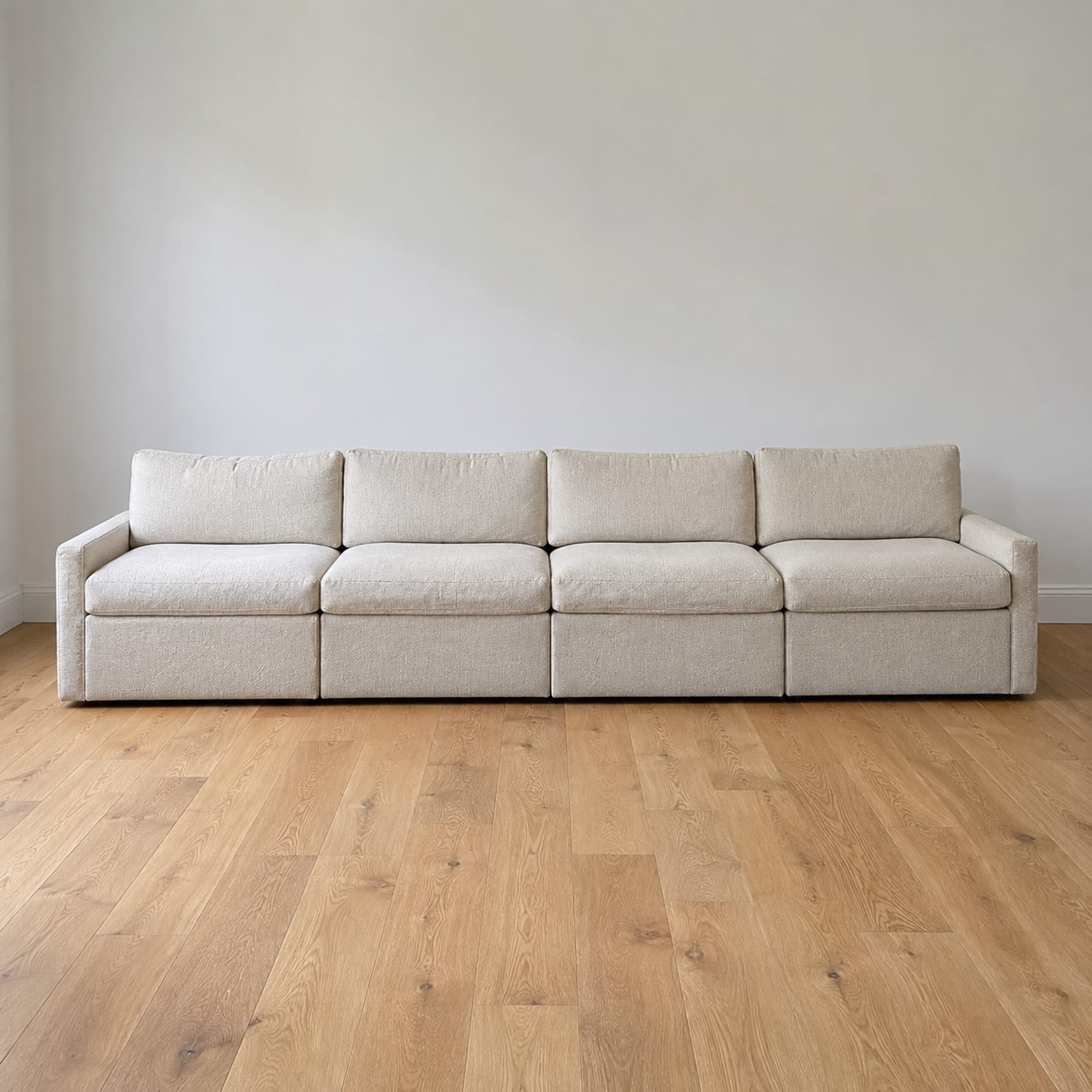
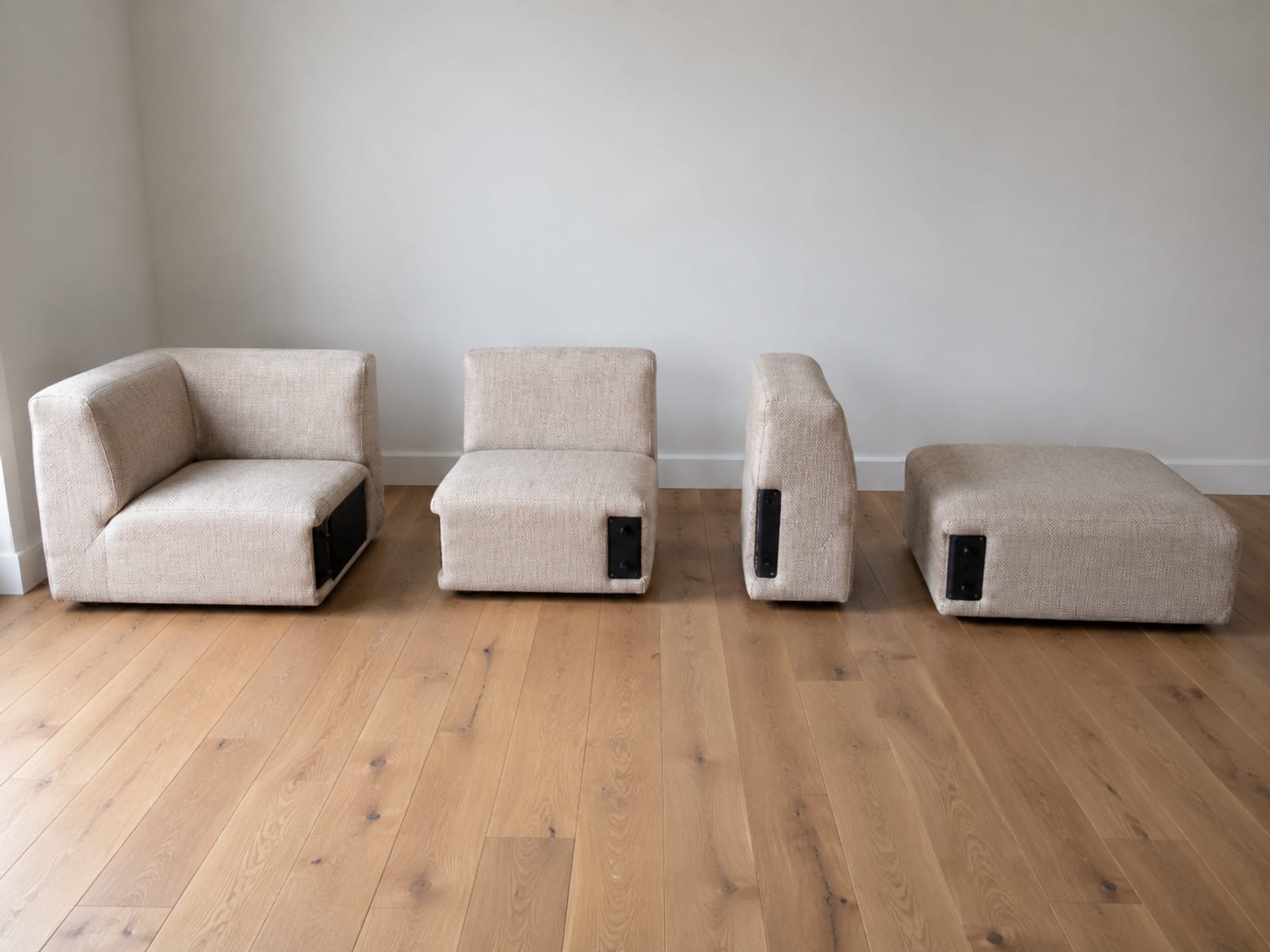
A modular sofa is seating built from sections the maker handles and sells as separate pieces, joined into one layout that can be rearranged as far as that maker's connection system and available modules allow. A chaise on one end does not make a sofa modular. The test is whether the product page lists the sections on their own, a seat, a corner, an armrest, an ottoman, and says how they hold together. IKEA lists SÖDERHAMN that way, as separate 3-seat, corner, 1-seat and armrest components. Most sofas sold as sectionals arrive as one fixed shape you cannot change afterwards.
Key Takeaways
Modular is a construction word
It means the sections are sold and handled separately, not that the sofa has an L shape or a chaise.
Sectional is a shape word
It describes a finished outline. A sectional is only reconfigurable if its own page says the sections come apart.
The connection method is a published fact or it is nothing
IKEA tells JÄTTEBO owners to open the storage, take out the mounting brackets, rearrange, and refit them. Monvane's U-shaped page names seven configurations without naming a connector.
Adding pieces later needs two things
The brand has to still sell single modules, and it has to say they are compatible with what you already own.
The carton is what has to fit, not the sofa
One IKEA JÄTTEBO 1.5-seat module carton is 38 inches long and weighs 66 pounds 9 ounces, and that is one seat's worth.
The price range is wide
Named configurations ran from $519.99 to $1,568 in September 2026, and the top of that range is buying published specs as much as size.
What makes a sofa modular rather than just sectional?
The two words get used as if they mean the same thing, and on a lot of listings they nearly do. The difference that matters when you are spending money is how the thing is sold and how it is put together.
A sectional describes an outline. It is a sofa that covers more than one wall, or turns a corner, or has a chaise sticking out one end. Choosing between that outline and a plain sofa is its own decision, worked through in sofa versus sectional. Plenty of sectionals arrive as one finished piece and stay that way for as long as you own them. The shape you order is the shape you keep.
A modular system describes parts. IKEA's SÖDERHAMN pages list a 3-seat section, a corner section, a 1-seat section, an armrest and covers as their own items. A named four-seat corner combination with an open end measures 114 5/8 inches down one side, 75 5/8 inches down the other, 39 inches deep and 32 5/8 inches high, and it was $1,568 on ikea.com in September 2026. That price buys a specific set of pieces, and the pieces are the point. See the SÖDERHAMN sectional listing for the component breakdown.
So, when a page calls something modular, look for the parts list. If the sections are only ever described as one product with one price and one photo, you are reading a sectional that has borrowed the word.
How do the modules actually stay together?
This is the question most product pages answer worst, and it is the one that decides whether the flexibility you are paying for is real.
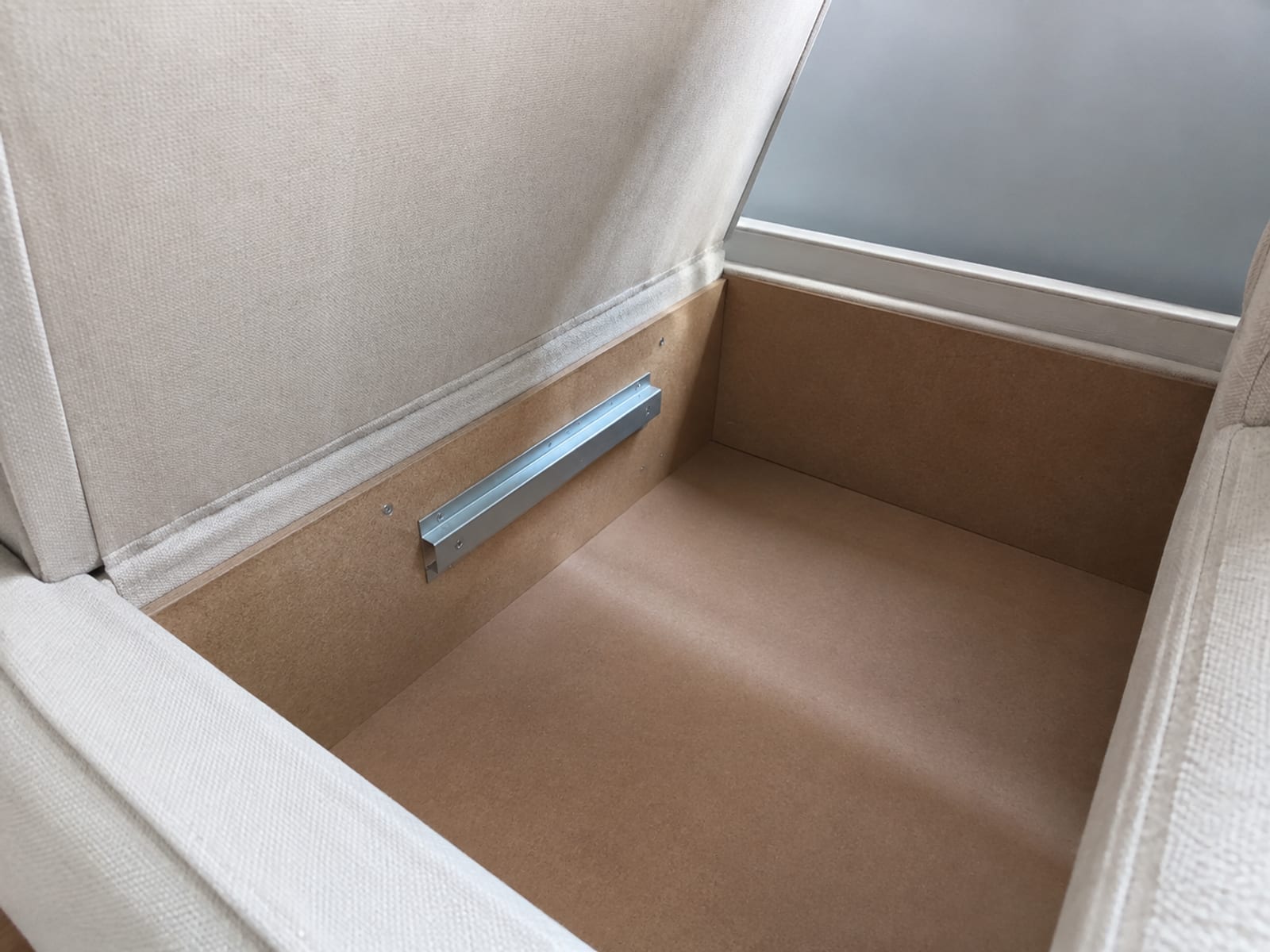
IKEA publishes a method for JÄTTEBO. The owner opens the under-seat storage, removes the mounting brackets, moves the modules to a new arrangement, and fixes the brackets back. No tools are needed and the whole process is described on the product page, which means you can read it before you buy and know what a Saturday rearrangement involves. That is on the JÄTTEBO 1.5-seat module page.
Monvane's U-Shaped Modular Couch is described as boneless and glue-free with seven flexible configurations, and a reader looking for the connector will not find one named on that page. That is not the same as saying there is none. It means Monvane's listing tells you the shape can change and leaves you to work out how on delivery day. If the way it holds together matters to you, and it should if you plan to move the pieces more than once, ask the seller before you order rather than after.
Carry that check to any listing you open. A published connection method tells you what rearranging will actually involve on a Sunday afternoon. A count of configurations, with nothing behind it, only tells you how many photographs the brand was able to take.
Can you really add pieces later?
Marketing for this category leans hard on the idea that you buy two seats now and a third next year. Sometimes that is exactly right. Whether it is true of the sofa in front of you depends on facts that are easy to check and easy to skip.
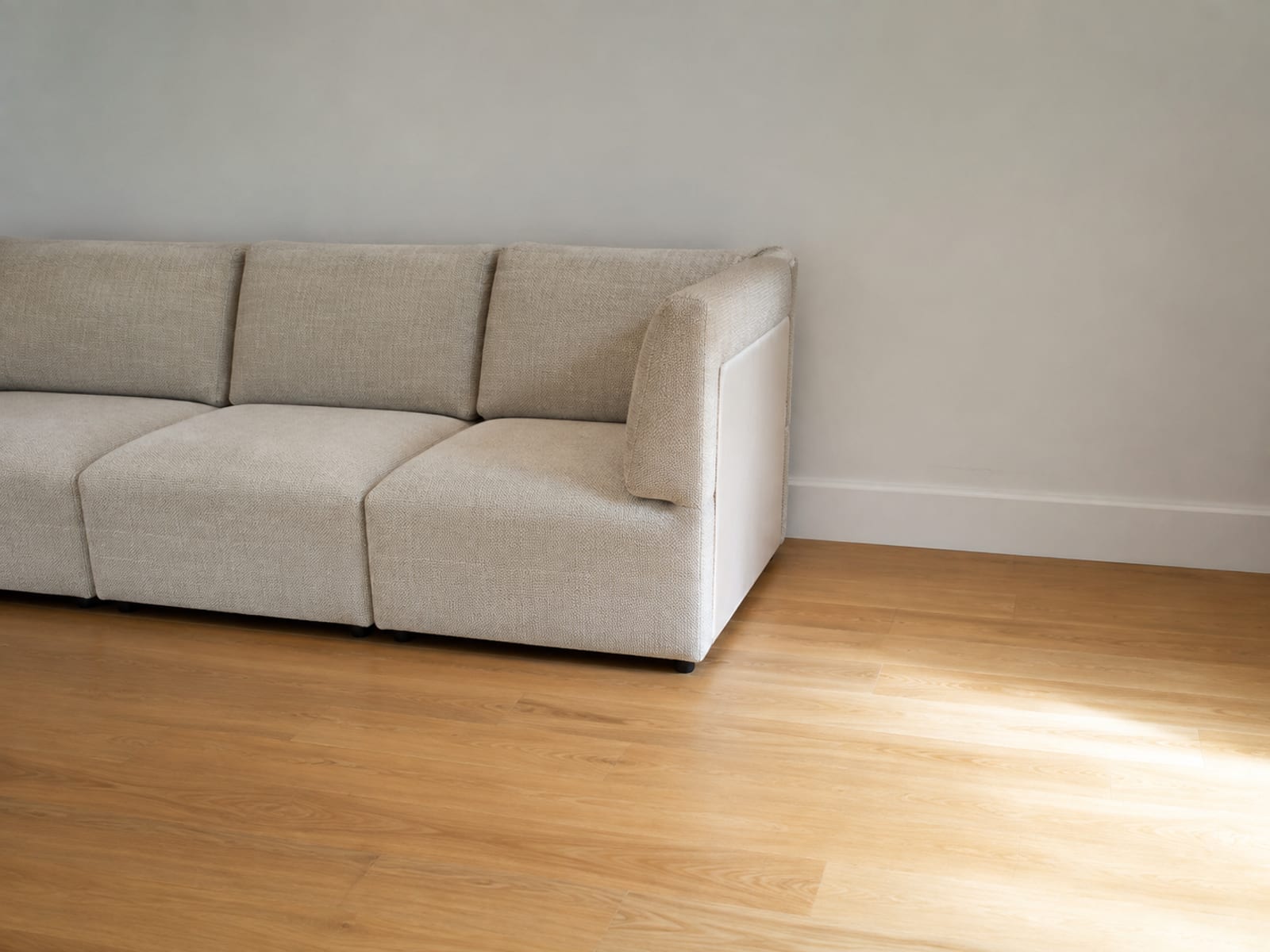
Start with whether the brand sells single modules at all. IKEA does, which is why a JÄTTEBO 1.5-seat module with storage has its own page and its own price, $670 on ikea.com in September 2026. Then look for a statement that today's module is compatible with the one you already own. Ranges change, fabrics get retired, and a piece that no longer matches is not an addition, it is a mismatch.
Monvane's U-shaped listing names seven configurations, which is a statement about how you can arrange what arrives in the boxes. It is not a statement that single pieces can be bought separately later. Those are different promises, and only one of them is on that page.
If growing the sofa later is the reason you are buying modular, that is the sentence to look for on the product page before anything else, and the question to ask support if it is not there.
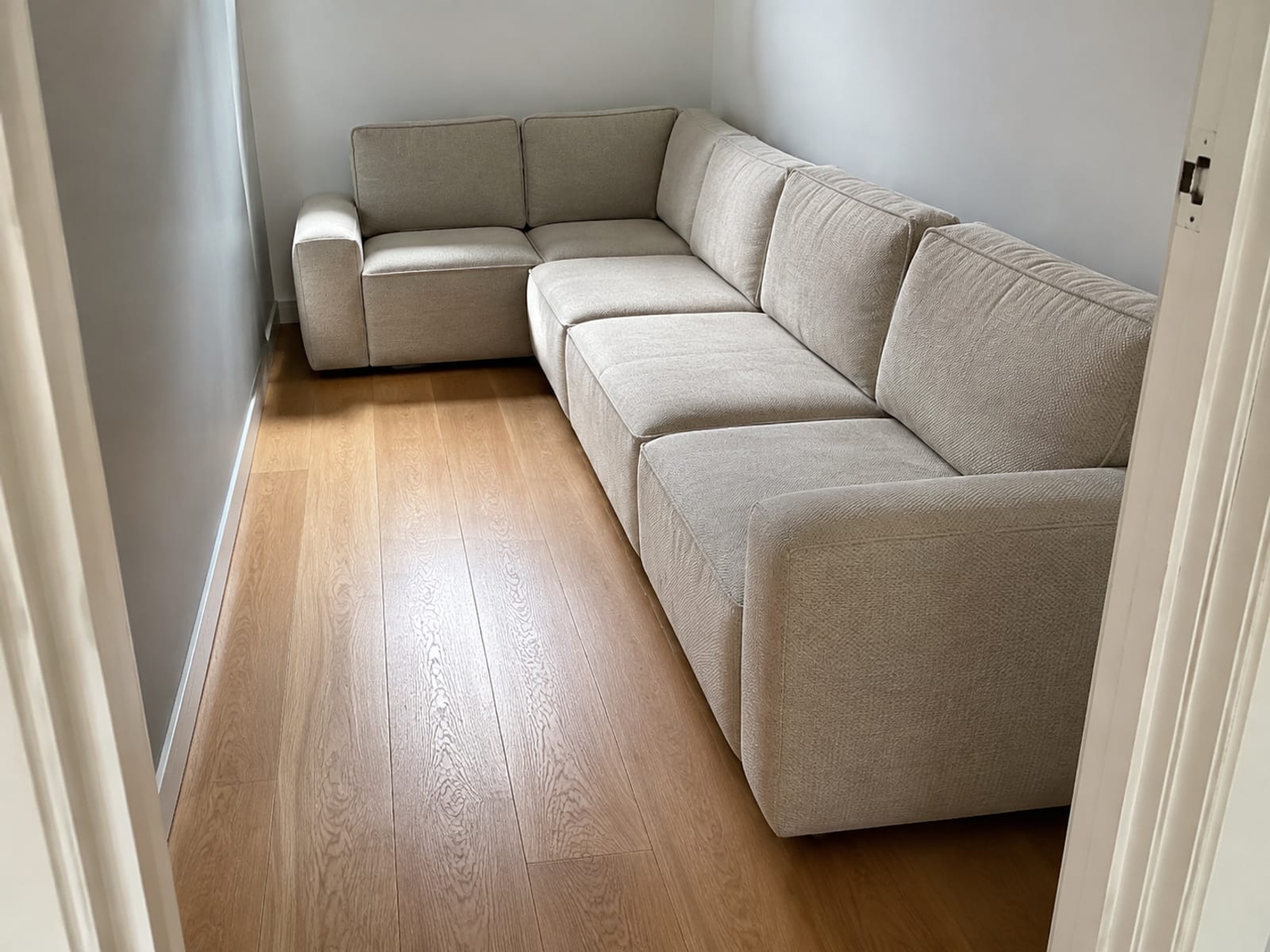
What does a modular sofa commit your room to?
A modular sofa can be rearranged, but every arrangement covers the same amount of floor, and the published dimensions for sofas and sectionals show how much that tends to be. The finished footprint is what the room has to absorb, and it does not shrink when you move the pieces around. The arrangement that closes the middle has its own name and its own trade, covered in what a pit sectional actually is.
Monvane's L-Shaped Modular Couch is 103 inches wide and 65 inches deep. The U-Shaped is 130 inches wide and 65 inches deep. Both were listed with a 27.5-inch seat depth in September 2026, at $519.99 and $749.99 respectively on monvane.com. Those are generous seats, and 65 inches of depth is a big commitment in a room that also has to hold a path to the kitchen.
That path is the part people forget. One renter on the r/Apartmentliving board described two couches arranged in an L that left everyone shimmying behind them to reach the kitchen, the bedroom or the balcony. What they wanted was seating for about six people that did not close off the room. In the same thread, a poster suggested a figure they go by: about 20 inches to squeeze past furniture, and about 24 inches for a walkway that feels comfortable. That is one person's rule of thumb rather than a building code, but it gives you something to put a tape measure against.
Mark the finished configuration on the floor with tape before you order, walk the route you actually use every day, and see what is left. The full version of that exercise is in how to measure a room before you choose a sofa. A shape you can rearrange later is small comfort if every arrangement blocks the same doorway.
If a television is the reason the room is laid out the way it is, set the seat position first and let the screen follow. Samsung's own starting point is viewing distance in inches divided by two, so a seat nine feet back, or 108 inches, points at roughly a 60-inch screen as the smallest it would choose. That comes from the Samsung viewing distance guide and it is display advice, not a sofa rule, but it stops the sofa landing somewhere the television was never going to work.
Will the boxes get up your stairs?
This is the part modular sofas are best known for, and the part where the claims run ahead of the numbers.
A modular sofa arrives in pieces, so no single object is as long as the finished sofa. That is a real advantage over a fixed sectional and it is why one r/Apartmentliving poster with a sofa stuck in storage went looking for a modular replacement. Their stairs had minimal clearance and a 180 degree turn, and the sofa they owned was never going to make it around the corner. Their account of it is the clearest version of the problem: the front door was never the hard part.
The oversell is the claim, repeated widely, that modular sofas fit easily through tight hallways and small doorways. Published carton dimensions do not support that as a general rule. IKEA publishes carton sizes for the JÄTTEBO 1.5-seat module, and they are not small: one is 38 by 29 1/2 by 17 3/4 inches and weighs 66 pounds 9 ounces, another is 38 1/4 by 28 1/2 by 10 1/2 inches and weighs 35 pounds 4 ounces. A 38-inch box is not small, and 66 pounds is a two-person lift up a staircase with a turn in it.
Hover or tap a row to highlight it.
| Product | Packages | Published carton sizes | Heaviest published carton |
|---|---|---|---|
| IKEA JÄTTEBO, 1.5-seat module with storage | 3 | 38 x 29 1/2 x 17 3/4 in, and 38 1/4 x 28 1/2 x 10 1/2 in | 66 lb 9 oz |
| Monvane L-Shaped Modular Couch | 2 | Not published | Not published |
| Monvane U-Shaped Modular Couch | 3 | Not published | Not published |
Measure the narrowest point of the whole route, not just the last doorway: the entry, the hallway, the landing, the turn, and anything hanging from the ceiling above the turn. Then compare it to the largest carton, and to the same carton tilted, because a turn is measured in two directions at once. Where a brand does not publish carton sizes, ask before ordering. A third-floor renter on r/femalelivingspace had stairs that had already defeated one sofa and a $1,500 budget, and was looking specifically for something small enough to come up in pieces.
When it does arrive, move every box to the room it belongs in before opening any of them. Monvane's own setup guidance is to get the packages inside, cut the compression bags, and let the sofa expand on its own, and it puts a 48-hour recovery period on its Oversized Sofa Bed. Compressed foam looks disappointing for the first day and that is normal.
What does a modular sofa cost, and what does more money buy?
Before the price, one thing worth settling is what fills the cushions, because a sectional multiplies whatever the fill asks of you by every seat you buy.
Named configurations read in September 2026 ran from $519.99 to $1,568 before delivery and tax. Monvane's L-Shaped Modular Couch was $519.99 and its U-Shaped was $749.99, both on monvane.com. IKEA's JÄTTEBO 1.5-seat module with storage was $670, and the SÖDERHAMN four-seat corner combination with an open end was $1,568.
What the higher end tends to buy is published detail rather than more sofa. IKEA states 2.2 pounds per cubic foot high-resilience polyurethane foam in the JÄTTEBO seat cushion, plus a steel pocket spring unit, plus a 10-year limited warranty on the named pages. Monvane lists 30D foam at 1.87 pounds per cubic foot and a two-year warranty, extended to three with registration. Foam density on its own does not settle comfort, because the thickness of the layer and what sits under it are not the same between the two, but a number you can compare beats a fabric adjective.
Abrasion claims are the one place to be careful. IKEA's SÖDERHAMN Tonerud cover says it handled 50,000 cycles and the JÄTTEBO page says 25,000, and neither page names the test method. ASTM D4157 and ASTM D4966 describe different machines, and D4966 says plainly that laboratory abrasion is one factor among several and should not be used on its own to predict how long something lasts in a house. Read those cycle counts as each brand's own claim, not as a scoreboard.
If a boneless chenille modular in the low end of that range is what your room and budget point at, the Monvane L-shaped is the configuration those figures belong to.
Can you read a modular listing?
1. A sofa has a chaise on one end. Does that make it modular?
2. A listing says "seven flexible configurations" and names no connector. What have you been told?
3. Which measurement decides whether it reaches the third floor?
Pick an answer to begin.
Frequently asked questions
What are the disadvantages of modular sofas?
The real ones are specific to the product rather than the category: a configuration can eat a lot of floor, with Monvane's U-shaped example at 130 by 65 inches, and single modules can still be heavy, with one IKEA JÄTTEBO carton at 66 pounds 9 ounces. The third is quieter, which is that flexibility is only as good as the connector and compatibility information the maker publishes.
How long do modular sofas typically last?
No standard or manufacturer specification puts an average number of years on a modular sofa, so treat any figure you see as somebody's estimate. Warranty terms are the closest published fact: IKEA states 10 years limited on the named SÖDERHAMN and JÄTTEBO pages, and Monvane states two years, extended to three with registration. A warranty is coverage, not a life expectancy.
Which brand is best for modular sofas?
No independent body ranks modular brands, so the honest answer is the one whose published numbers match your room. Compare the finished footprint, every carton dimension against your route, seat depth and height, the connector and replacement-part policy, cover care, price and warranty for the exact configuration you would order.
Is modular furniture durable?
Durability comes from what a maker publishes about the frame, the foam, the cover and the connectors, not from the word modular. A pocket spring unit and a stated foam density tell you something; a rub count with no named test method does not, and a removable washable cover is a maintenance feature rather than a strength claim.
Do modular sofas need assembly?
The boneless ones generally do not. Monvane says its U-shaped model needs no tools, and IKEA describes moving and refixing JÄTTEBO modules without tools too. What both need is space and time: cartons carried in before they are opened, and compressed foam given its stated recovery period, which Monvane puts at 48 hours for its Oversized Sofa Bed.
The words on a modular listing
Tap a term to see what it means.
Module. A section the maker sells and ships as its own item, with its own dimensions and often its own price. If it has no page of its own, it is probably not a module.
Modular is worth the extra reading when the pieces solve something a fixed sofa cannot, a staircase with a turn in it, a room whose layout you have never quite settled, or a household that is about to change size. When none of those apply, a fixed sectional does the same job for less money and less homework. Either way, the numbers you need are the finished footprint, the largest carton, and the connector, and any listing worth buying from will give you all three. PlushPick compares the modular sofas themselves in its buying guide, once the definition is out of the way.
Cal Hewitt
Writer at PlushPick. I compare sofa specs, comfort, durability, and value so you can buy with clearer expectations.
About Cal and how the guides are researchedThe latest
 "Best-of"Best Furniture Protectors for Pets, by What They Actually Cover
 "Best-of"Best Pet-Friendly Sofa Fabrics: Claws, Hair and Spills
 "Best-of"Best Sofas for Small Spaces: Narrow Doesn't Mean Shallow
 "Best-of"Best Recliner Covers for Dogs: What Actually Stays On
 AnswerSofa vs Sectional: Which One Fits Your Room and Life
 AnswerHow to Measure a Sofa So It Fits Through the Door