

Affiliate disclosure. If you buy through a link on this page, PlushPick may earn a commission at no extra cost to you. That never changes which products are named or what is said about them. As an Amazon Associate I earn from qualifying purchases. How this works
Before the cloth touches the leather, find out which leather it is. Top-grain, aniline, nubuck and synthetic all get sold under the same word, and a wipe that is routine on one of them can be permanent on another. For ordinary finished top-grain, the sequence is short: lift the loose grit off with a soft brush vacuum attachment, blot a fresh spill with a clean white cloth working toward the middle of the mark, test your cleaner somewhere hidden and let that test dry, then wipe gently without soaking anything. After that it is mostly waiting. Leather rarely fails because somebody used the wrong technique. It fails because somebody would not leave it alone long enough.
Key Takeaways
Find out what the material is first
Top-grain, aniline, nubuck or suede, and synthetic each take a different cleaner. Room & Board tells its own customers to confirm which one they own before cleaning or conditioning anything.
The hidden test is not optional
Dampen a cloth, try it somewhere nobody sees, and let that patch dry completely before you go near the mark.
Blot toward the middle of the mark
Do not rub it. Crate & Barrel says scrubbing damages the protective finish, and it is the damaged finish that later cracks.
The clock is the hard part
Leather Honey publishes at least 24 hours of drying after cleaning before any conditioner, then at least 2 hours after conditioning and preferably overnight.
Condition when it feels dry
Room & Board's trigger is leather that feels dry or looks lighter than it did. Leather Honey says six months and Crate & Barrel says twice a year, and the three of them do not agree.
Keep the harsh cleaners off it
Bleach, ammonia, acetone, window cleaner and anything alcohol based are all named on Crate & Barrel's own care page.
What kind of leather is on your couch?
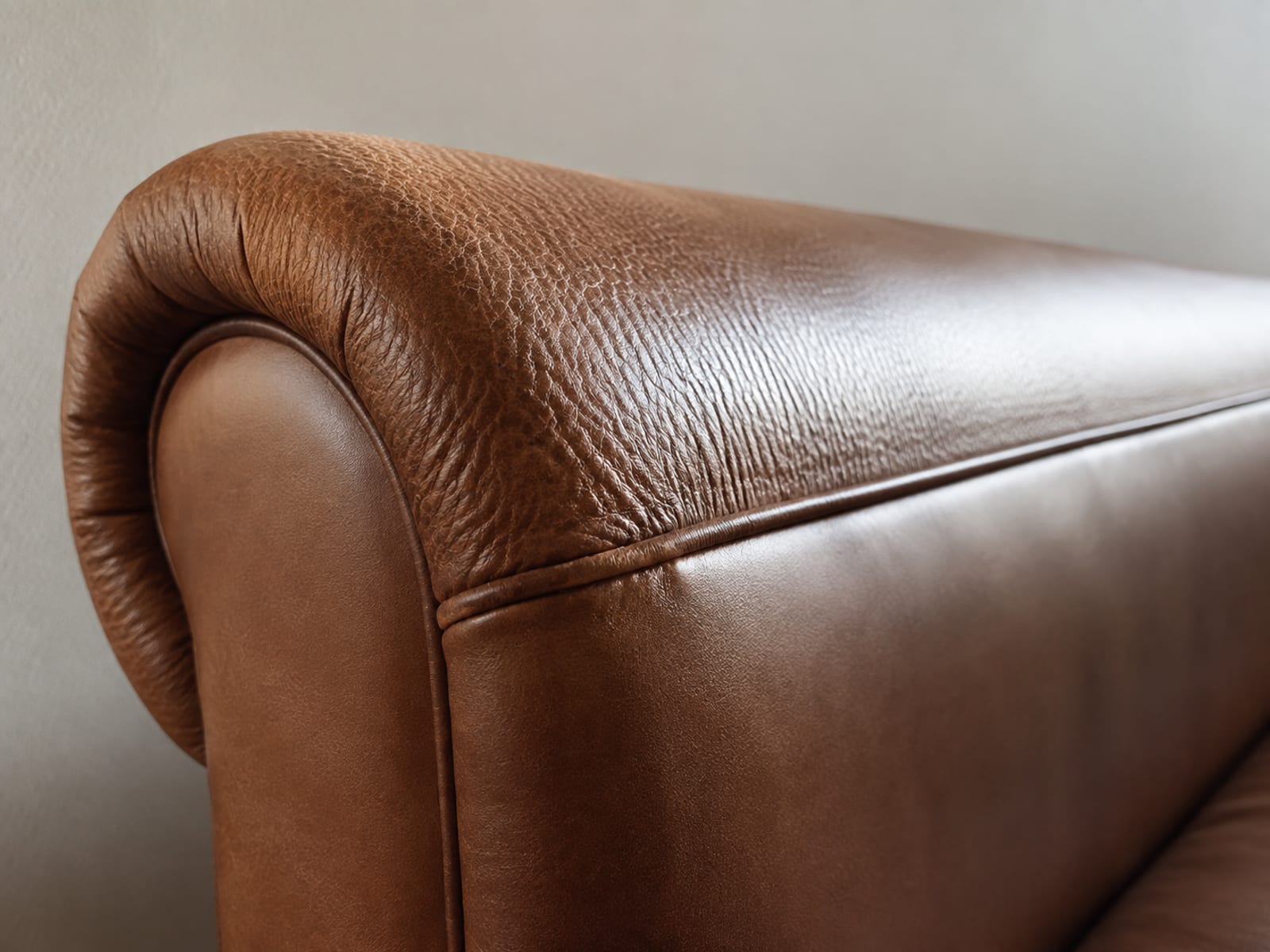
This is the FINISH, which decides what you may put on it. The GRADE, meaning which layer of the hide you bought, is a different question answered at the point of purchase in the leather sofa guide.
This is the step people skip, and it is the one that decides everything after it. If you are still choosing rather than cleaning, what the leather cover costs on the same frame is the question that comes first. Room & Board's care page asks buyers to confirm whether what they own is top-grain, nubuck or synthetic before cleaning or conditioning it, because those three do not take the same product. You can see the same thing on the back of the bottles. Leather Honey's cleaner says it is not for suede. Its conditioner says it is not for suede, faux leather or vinyl. Bickmore's Bick 4 says it is for smooth, finished leather and not for suede, roughout, distressed, napped or pre-treated leather. Every one of those exclusion lists is different, and every one of them assumes you already know which camp your couch sits in.
Crate & Barrel's leather guide gives the vocabulary. Full-grain keeps the natural surface, so the markings and grain stay visible. Top-grain has had that outer surface buffed for a smoother, more uniform look. Full-aniline shows more of the hide's own detail and color variation, while semi-aniline is more even. Those are not decorative distinctions. The more finish a hide carries, the more it tolerates; the less it carries, the more a wet cloth is absorbed rather than wiped away.
Hover or tap a row to highlight it.
| Family | What you are looking at | What it takes |
|---|---|---|
| Finished top-grain | Buffed outer surface, smooth and uniform in color | The full cleaning sequence, with a maker-approved cleaner after a hidden test |
| Full-aniline or semi-aniline | Visible hide detail and color variation, less coating over it | The same sequence, but the hidden test matters more, because there is less finish between the cloth and the hide |
| Nubuck or suede | Napped, velvety surface rather than a smooth one | Its own maker's directions. Leather Honey's cleaner and conditioner both say not for suede |
| Synthetic | Not hide at all | A damp cloth only for minor spills. Room & Board publishes no soap, no harsh detergent, no excess water, and at least 12 inches from a heat source |
If the tag is long gone and you genuinely cannot tell, the hidden test does double duty. A drop of water on a hidden patch that sits on the surface tells you there is finish over the hide. One that darkens the spot and soaks straight in tells you there is not much, and that you should be talking to the furniture maker before anything else touches it.
What do you need before you start?
A vacuum with a soft upholstery brush. Two clean lint-free or microfiber cloths, plus a separate white one for blotting, because a colored cloth can leave dye behind on a damp surface. A cleaner your furniture's maker approves. A conditioner, if it turns out you need one. And something to keep time with, which sounds fussy until you are standing there wondering whether it has been long enough.
What stays in the cupboard is a shorter list. Crate & Barrel names bleach, ammonia, acetone, window cleaner and alcohol-based cleaners as products to keep off leather. It also says not to scrub. That instruction is doing more work than it looks like it is doing, because scrubbing is what damages the protective finish, and a damaged finish is the thing that later becomes vulnerable to cracking and scratching. The scratch you are trying to avoid in five years usually starts as a hard rub tonight.
How do you clean it without taking the finish off?
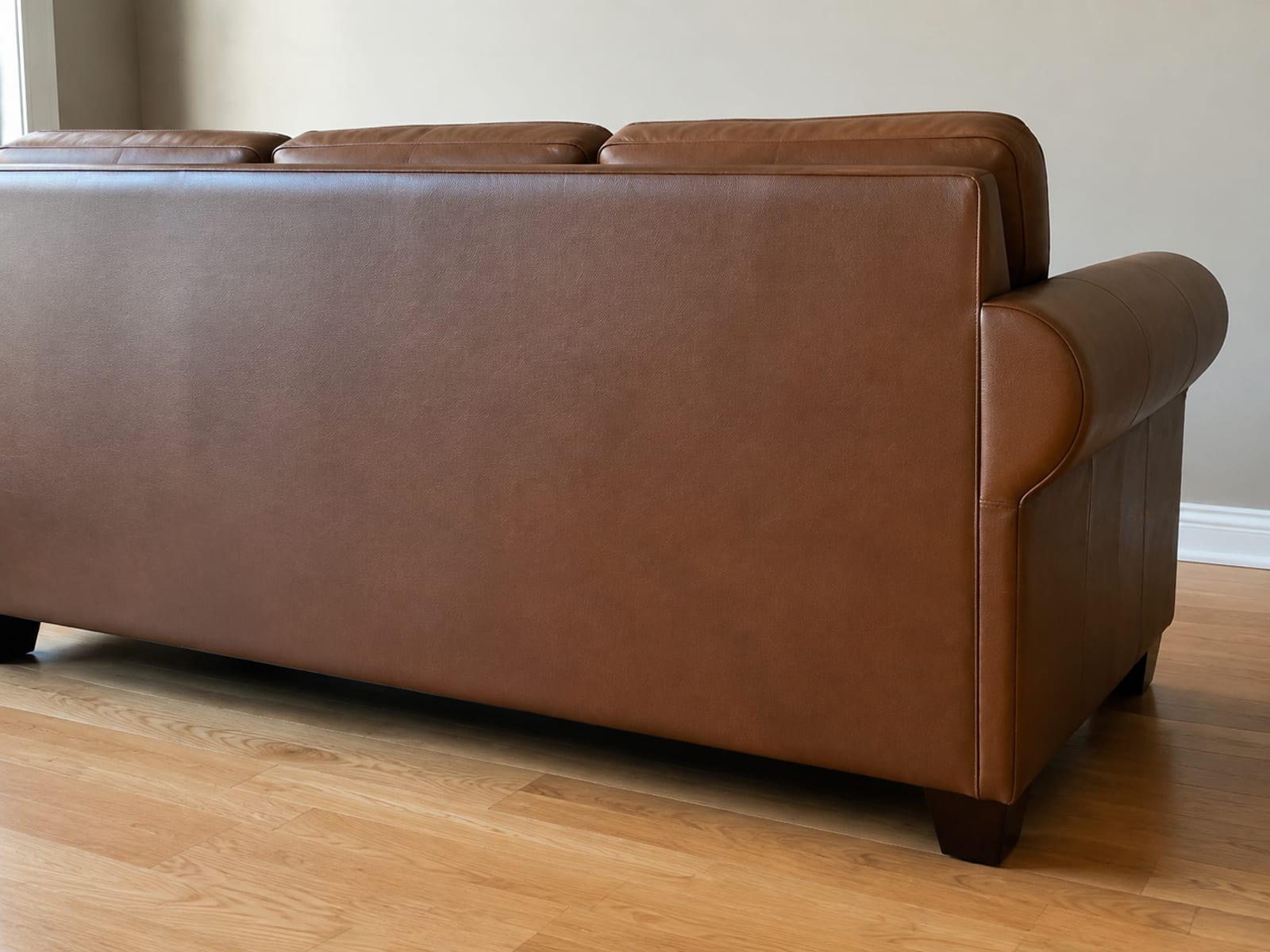
This is the low-risk sequence for finished top-grain leather, where the furniture's maker has not published something different. None of it applies to nubuck or suede, which need their own maker's directions.
1. Read the care instructions first. Confirm the material. These steps assume finished leather. 2. Take the dry soil off. Vacuum the crevices with the soft upholstery attachment and wipe the flat surfaces with a dry cloth. Crate & Barrel puts this on a weekly rhythm, and the reason is mechanical rather than cosmetic: grit that stays on the seat gets ground into the finish every time somebody sits down. 3. Blot a fresh spill immediately. Clean white cloth, working toward the center of the mark so you are not pushing it wider. Room & Board is explicit that you do not rub. 4. Test the cleaner where nobody looks. Dampen the cloth, try it on a hidden area, and let that patch dry before you decide. Testing on the stain itself is how people end up with a clean mark in a slightly different color from the rest of the cushion. 5. Clean lightly and do not saturate. Wipe gently and concentrate on the soiled part. If you are using a concentrate rather than a ready-to-use bottle, follow that bottle's own dilution; Leather Honey publishes 1 ounce of cleaner to 8 ounces of water for its 4 ounce concentrate, and that ratio belongs to that product and no other. 6. Let it dry all the way. This is where most of the damage gets done, and it takes longer than anyone wants it to. 7. Condition only if it needs it, only when it is clean and dry, and only if the maker allows it. 8. Go back to the boring maintenance, which is what keeps you from doing any of this again for a while.
Is dish soap, vinegar or a baby wipe safe on leather?
Crate & Barrel permits mild soap and warm water on its leather, after blotting, as part of its own spill sequence. Leather Honey says the opposite for its products: use a made-for-leather cleaner and skip the household solutions, and it names vinegar and baking soda mixes specifically as ones to leave alone. Neither of them is wrong. Each is publishing about the finishes it knows. The tiebreak is the maker of your couch, because that company knows what coating is on your hide, and a cleaner company does not.
So, if your sofa's maker permits mild soap and water, mild soap and water is fine, after the hidden test. If it does not, or you cannot find out, use a product made for leather rather than improvising with something from the kitchen sink.
The baby wipe deserves its own answer, because it is what most people already have in the house. One owner on r/Leather described going over a couch repeatedly with soapy baby wipes and ending up with areas that had gone sticky, then asked whether the couch was finished. A commenter who repairs seats for a living replied that damage to the coating can be permanent and may need the color stripped and put back on. That is one account rather than a study, and it does not prove anything about every wipe on the shelf. What it does show is the failure mode: the trouble was not one wipe, it was many wipes over time on a coating that was slowly giving way. Crate & Barrel's own exclusion is alcohol-based products, and wipe formulas vary from brand to brand, so there is nothing on the pack that tells you which kind you are holding.
How long does it need to dry?
Longer than feels reasonable, and this is the part of leather care that nobody enjoys.
What the waiting actually looks like
- 1
Right away
Blot the spill. Speed matters here and nowhere else in the process.
- 2
Hidden test, then dry
Let the test patch dry completely before you judge it. A damp patch and a dry patch are different colors.
- 3
After cleaning, at least 24 hours
Leather Honey publishes this as the gap before any conditioner goes on, when you can manage it.
- 4
After conditioning, at least 2 hours
Its product directions say a minimum of two, and say overnight is better.
- 5
At 24 hours
Wipe off any conditioner that has not been absorbed.
Do not try to shorten it with heat. Room & Board publishes a clearance of at least 1 foot, 12 inches or 30.5 centimeters, from a heat source for its synthetic leather, and while that exact figure is written for synthetic, the sun is worth avoiding on any of them. A radiator or a hair dryer dries the surface faster than the material underneath it, which is the opposite of what you want.
That clock has a practical edge to it. If somebody sleeps on this couch, do not condition it on a night it is needed, because the product wants at least two hours and would rather have the whole night. And if the couch is the only seating in a small apartment, clean one cushion or one section at a time rather than putting the whole thing out of service for a day.
When should you condition it, and how often?
Leather Honey says at least once every six months. Crate & Barrel says twice a year. Room & Board does not give an interval at all and gives a condition instead: top-grain leather wants conditioning when it feels dry to the touch or starts looking lighter than it did.
Take your own furniture maker's answer first if you have it. Failing that, the condition trigger is the safer of the two approaches, because a calendar tells you nothing about how much sun that end of the couch gets or how often anybody sits there. Leather that still feels supple does not need anything doing to it.
When it is time, the application is smaller than people expect. Leather Honey's directions are a quarter-size amount on a clean dry lint-free cloth, spread in a thin even coat, never poured onto the leather itself. Then at least two hours, preferably overnight, and buff off whatever has not soaked in. If only one arm has gone dry, resist treating that arm alone; a conditioned patch can come back a different shade from the panel next to it, so work the broader area the way the maker directs.
The prices, if you are pricing this out: Leather Honey's 8 ounce conditioner is $27.99 on leatherhoney.com as of September 2026, its 8 ounce ready-to-use cleaner is $24.99 on its own product page, and the kit with both plus two cloths is $43.99 as of the same month. Bickmore's Bick 4 is another option sold on Amazon, described by its maker for smooth finished leather with the exclusions listed further up, and it also directs you to test a hidden area first. Room & Board names Guardsman Clean & Renew for its own top-grain pieces, which is the pattern worth copying: ask your furniture's maker what it approves rather than picking on reputation.

What keeps you from doing this again?
The routine is dull and it works. Crate & Barrel's weekly step is a dry cloth over the surfaces and the soft brush attachment through the crevices, with a deeper clean about every other month. Where the cushions come off, it says to rotate them every three months, which spreads out the body oils and the contact wear instead of letting one seat take all of it. Keep the whole thing out of direct sun. Blot spills when they happen rather than when you get around to it, because a fresh spill is a blotting job and a dry one is a cleaning job.
And keep coming back to the one instruction that costs nothing: gently. Each of those failures, the sticky patches, the color coming away, the finish that cracks later, starts with somebody pressing harder because it was not working.
When is it a job for somebody else?
Room & Board's own guidance says to call a professional upholstery cleaning company for a large or persistent stain, and there is no shame in the couch being past a cloth. A few situations are professional jobs from the start.
A liquid that has soaked in rather than sat on top is one. A parent on r/toddlers described a toddler urinating on a leather couch and staying in it for 20 minutes, which is long enough for the problem to stop being a surface problem. So is a finish that has already been damaged, where the answer is repair, stripping and re-coloring rather than cleaning. So is anything involving damp that has got into the cushions. And if what you are dealing with is a smell rather than a mark, the surface is rarely where it lives, so working out which layer of a couch is holding the odor comes before any product does.
When you call somebody, the IICRC's standards index lists ANSI/IICRC S300 as the standard for professional upholstery cleaning, with S500 covering water damage and S520 covering mold. Asking a company which of those it works to is a fair question, and so is telling them three things before they arrive: what the leather is, how old the mark is, and whether the filling underneath got wet.
Would you get this one right?
1. There is a fresh coffee spill on a leather cushion and a cloth already in your hand. What happens first?
2. Where does a leather cleaner get tested?
3. Leather Honey publishes a minimum gap between cleaning a couch and conditioning it. How long?
4. Room & Board publishes a heat clearance for its synthetic leather. What is it?
5. Which of these does Crate & Barrel name as a product to keep off leather?
Pick an answer to begin.
Frequently asked questions
Can I use Dawn dish soap on my leather couch?
Crate & Barrel permits mild soap and warm water on its leather as part of its spill sequence, while Leather Honey tells people to use a made-for-leather cleaner instead of a household mix. Your own furniture maker's instruction settles it, because that company knows the finish on your hide. Whichever way you go, test it on a hidden patch first and let the patch dry.
What is the best cleaner for a leather couch?
The one your furniture's maker approves for the exact cover you own, tried on a hidden area before it goes near the mark. Room & Board points its own top-grain customers at Guardsman Clean & Renew, which is a useful model even if you own something else: the maker's recommendation beats a general one.
How often should I condition a leather couch?
Leather Honey publishes at least every six months and Crate & Barrel publishes twice a year, while Room & Board goes by feel, conditioning top-grain when it is dry to the touch or looking lighter. Follow your own maker first, then the feel test, and do not add a coat just because the calendar came round.
Will my leather couch crack if I never condition it?
What Crate & Barrel actually publishes is that aggressive cleaning and scrubbing leave the protective finish vulnerable to cracking and scratching, which puts the emphasis on how you clean it rather than how often you feed it. Keep it out of direct sun, clean it gently, and condition when it feels dry.
How long before anyone can sit on it again?
After conditioning, Leather Honey's directions ask for at least two hours and prefer overnight, then a buff to take off whatever did not absorb. After cleaning alone, let the surface dry fully before anything goes back on it, including throws and cushions, because trapped damp is its own problem.
The words on the label, and what each one means for cleaning
Tap a term to see what it means.
Full-grain. Leather that keeps its natural outer surface, so markings and grain stay visible. Less has been done to the surface, so less sits between your cloth and the hide.
The wait is most of the job here, so, plan the cleaning for an evening when nobody needs the couch. And if the mark turns out to be on a fabric cushion with a care tag sewn into it rather than on hide, then the letter on that tag decides which products are allowed near it, and the sofa-care guides at PlushPick pick it up from there.
Cal Hewitt
Writer at PlushPick. I compare sofa specs, comfort, durability, and value so you can buy with clearer expectations.
About Cal and how the guides are researchedThe latest
 "Best-of"Best Furniture Protectors for Pets, by What They Actually Cover
 "Best-of"Best Pet-Friendly Sofa Fabrics: Claws, Hair and Spills
 "Best-of"Best Sofas for Small Spaces: Narrow Doesn't Mean Shallow
 "Best-of"Best Recliner Covers for Dogs: What Actually Stays On
 AnswerSofa vs Sectional: Which One Fits Your Room and Life
 AnswerHow to Measure a Sofa So It Fits Through the Door