

Best Reading Chair for a Full Hour: Footrest or Deep Seat
The best reading chair comes down to your feet: a footrest in the box, or a seat deep enough to pull them up. Five named chairs, published figures and prices.
By Cal Hewitt, (updated )
Affiliate disclosure. If you buy through a link on this page, PlushPick may earn a commission at no extra cost to you. That never changes which products are named or what is said about them. As an Amazon Associate I earn from qualifying purchases. How this works
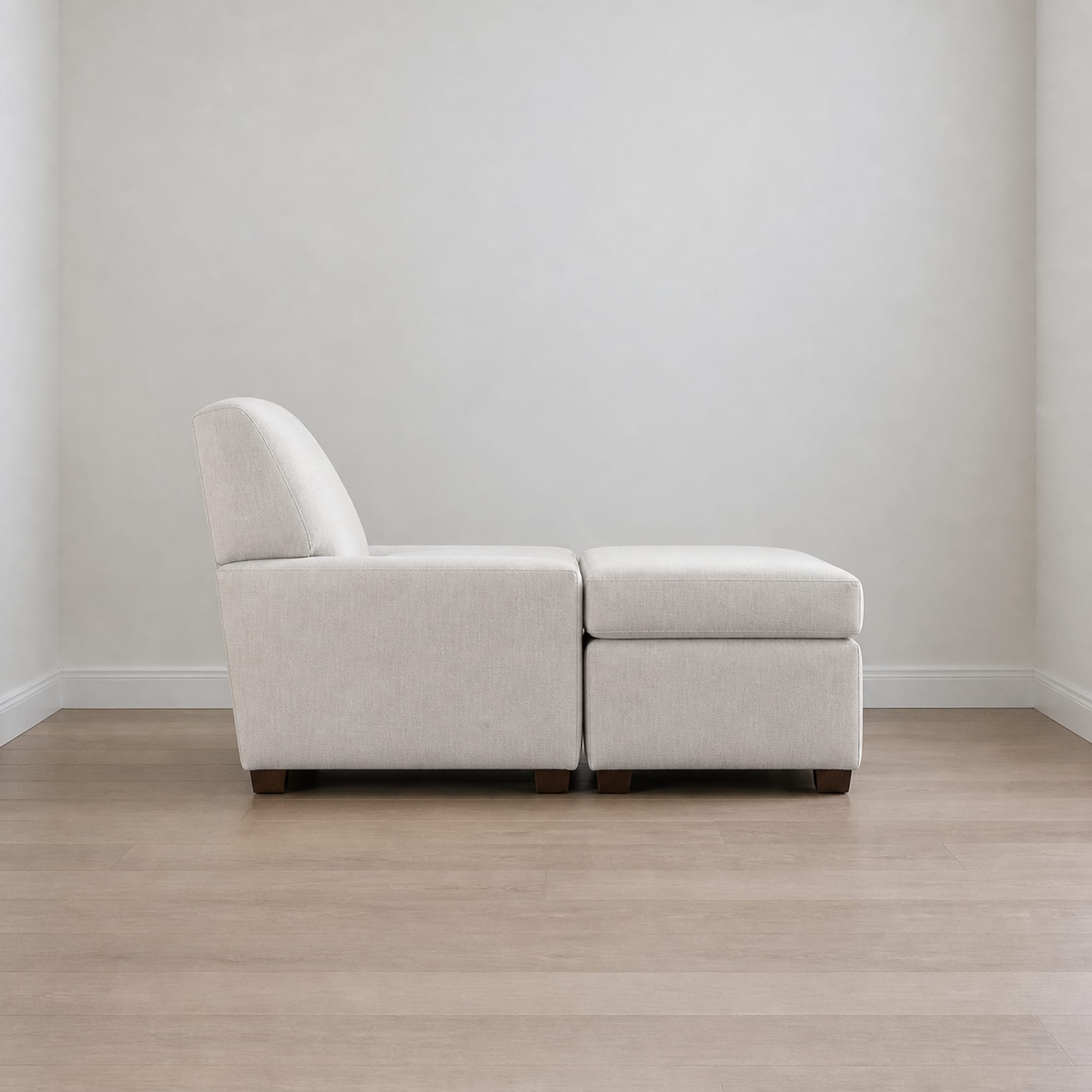
An hour in a chair is decided by your feet. Sitting upright with them flat on the floor is comfortable for about twenty minutes, which is why so many beautiful chairs end up being the one nobody sits in. The market publishes two answers to that, and they are priced hundreds of dollars apart: a chair that comes with a footrest, or a seat deep enough to pull your feet up onto. IKEA sells the POÄNG as a single product called an armchair and ottoman for $299. Room & Board's Eos solves the same problem with a 41-inch seat depth at $1,699 to $1,999. Work out which answer suits you before you look at a single photograph, and the shortlist writes itself.
At a glance
Key Takeaways
The hour is a feet question
Upright with your feet on the floor is a twenty-minute chair, whatever it looks like.
There are two published answers
A footrest in the box, or a seat deep enough to sit sideways on.
The price gap is enormous
$299 buys a chair and its ottoman; the deep-seat route starts around $1,699.
Seat depth spans two-fold
20.5 inches on the West Elm Penn against 41 on the Room & Board Eos, both sold as chairs to read in.
A stowable ottoman is a third answer
It gives the room its floor back when nobody is reading.
Diagonal depth is the number that gets it indoors
West Elm publishes 29 inches for the Penn Chair.
How these were judged
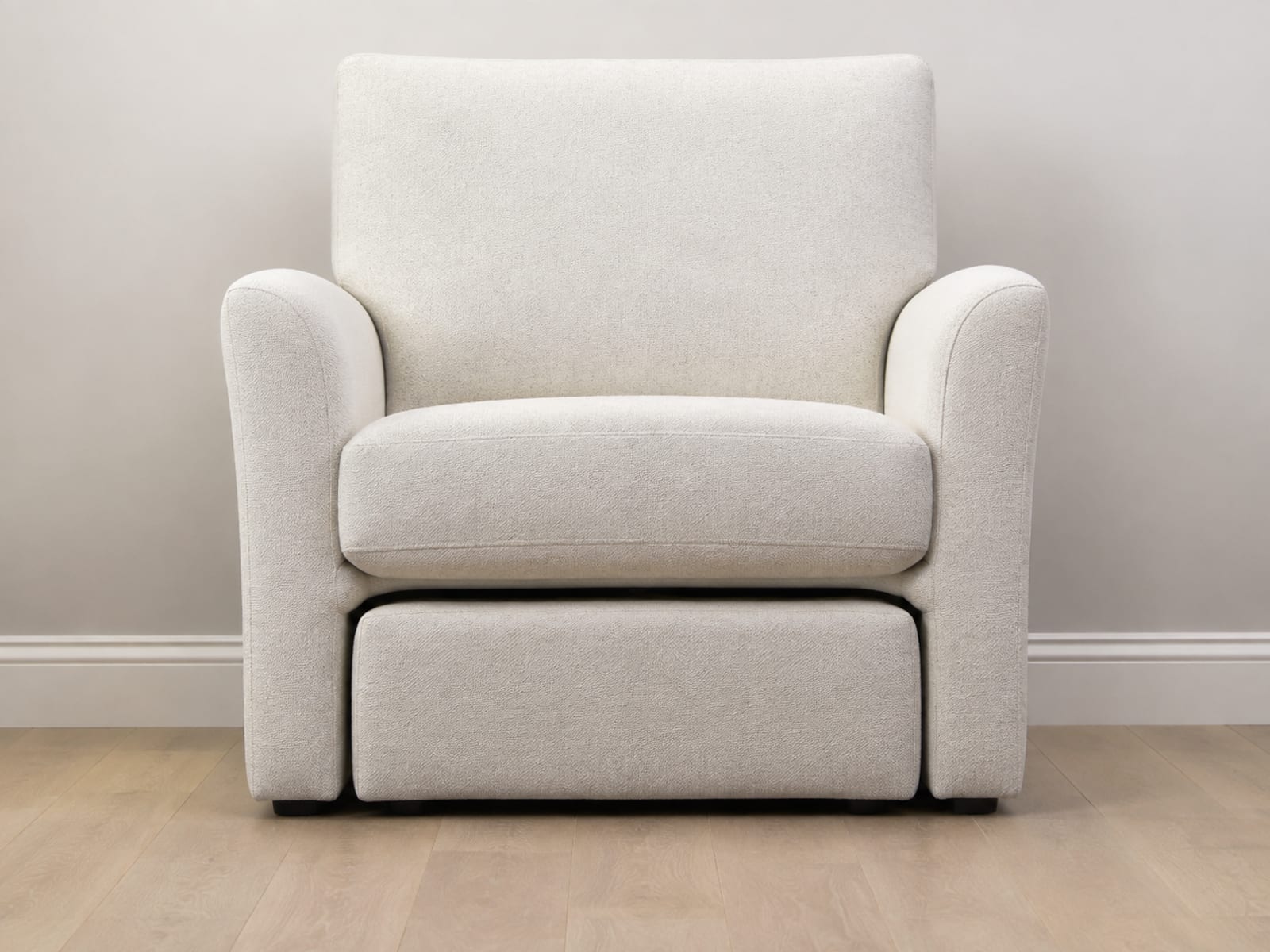
Every chair below was read on the seller's own page, and the first question asked of each was where your feet go for the second half of an hour. A chair that answers that with an included footrest, a stowable one, or a seat deep enough to fold your legs onto is a reading chair. A chair that answers it with nothing is an armchair, which is a fine thing to be and a different purchase.
After that, the checks were the ones that decide whether the chair arrives and stays: the published footprint, the diagonal depth where a seller gives one, the capacity, and what the maker says about the cover. Where a seller publishes nothing on a point, that is reported rather than filled in. Nobody here is ranked on how the chair looks in a photograph, which is the one part of this you will judge better than any list can.
Best chair and footrest as one purchase: IKEA POÄNG Armchair and Ottoman, black and Vissle deep green
The POÄNG settles the feet question by putting the footstool in the box. IKEA publishes it as a high back chair with a separate ottoman, with 2.2-pound-per-cubic-foot polyurethane foam, and the series carries a 10-year limited warranty. It was $299 on ikea.com as of September 2026, for both pieces.
That price is the reason it belongs at the top of a list like this rather than in the budget slot. Nearly every other chair here is a chair alone, so the moment you add a footrest to one of them you have changed the comparison. Buying the pair together also means they match in height, which sounds obvious until you have tried to read with your heels on an ottoman that sits two inches too high.
The frame is a bent-wood cantilever, so it has a small amount of give in it rather than sitting rigid. Whether that suits you is a sitting-in-it question, and it is worth doing before ordering if there is a store within reach.
Best high back at the same money, if the cover suits you: IKEA STRANDMON Wing Chair, Sulviken blue and beige
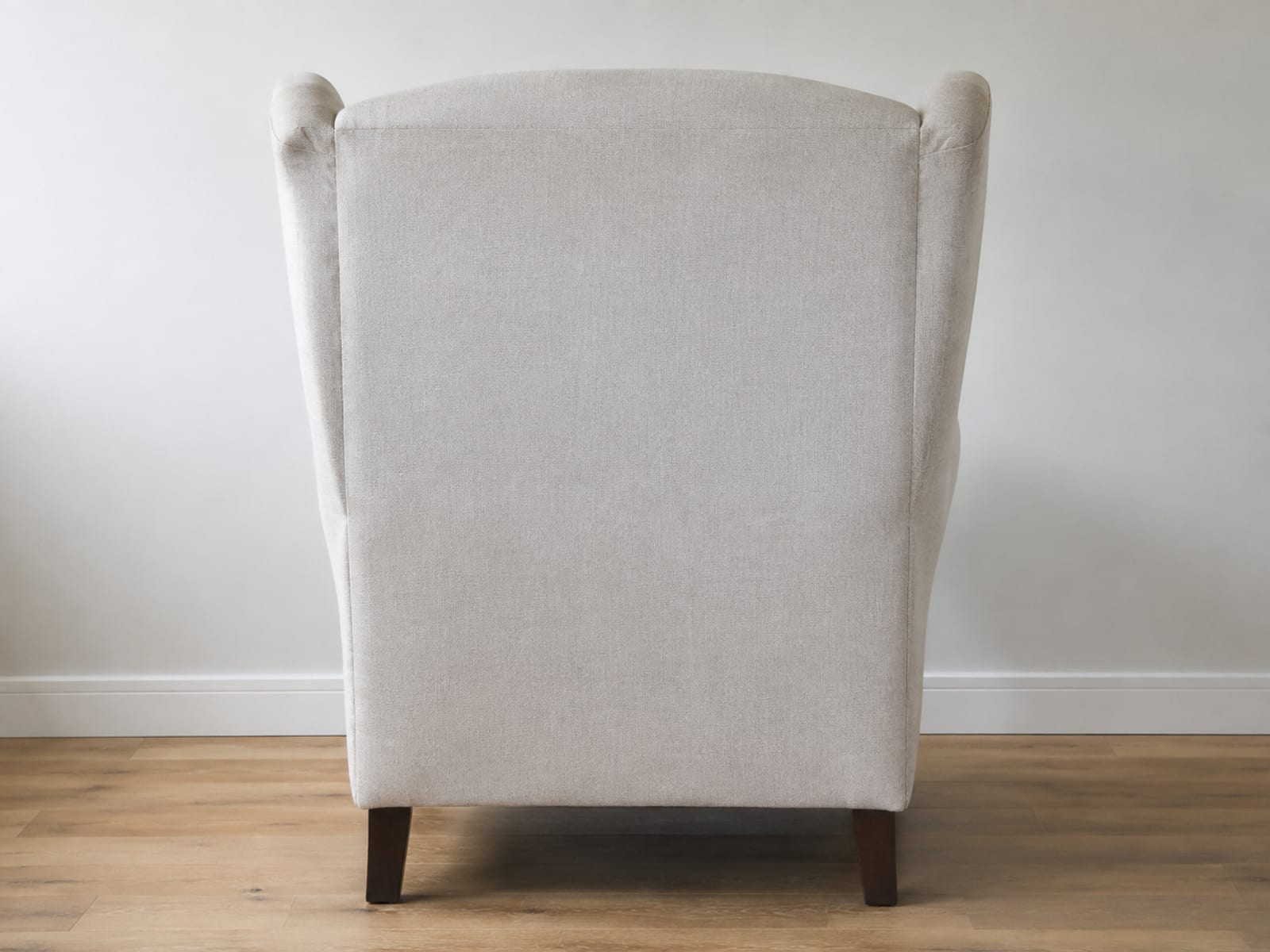
The STRANDMON is the wing chair people picture when they picture a reading chair, and it was listed at $299 as of September 2026. The wings are not decoration: they give your head somewhere to rest sideways, which is the position most people end up in after half an hour with a book.
Read the cover terms before you commit, because they are strict. IKEA states that the cover is not removable, that it should be vacuumed and wiped with a damp cloth, and that the cushion cover is not washable. In a house with a coffee habit or a dog that gets on the furniture, that is the deciding fact about this chair rather than a footnote.
One more thing worth knowing rather than hiding: a named IKEA reviewer, Peter, reports spending hours unable to align the arm screws during assembly. That is one linked account rather than a defect rate, and it is the kind of thing worth an extra half hour set aside rather than a reason to rule the chair out.
Best published figures in a compact footprint: West Elm Penn Chair, Performance Modern Chenille
The Penn Chair is the one that tells you the most before you buy. West Elm publishes 31.5 inches wide by 29.5 deep by 30.75 high, a 20.5-inch seat depth, a 17.75-inch seat height and a 275-pound capacity, at $499 on westelm.com as of September 2026.
More useful than any of those, it publishes a 29-inch diagonal depth. That is the measurement across the chair's corner, and it is the one that decides whether the thing gets through your door, up your stairs and around your landing. Most chair listings never mention it, and it is the single most common reason a piece has to go back.
The 20.5-inch seat is the shallowest here, which makes this an upright chair rather than a curl-up one. Pair it with an ottoman and it answers the hour; leave it alone and it is a handsome chair for a shorter sit. The published seat figures across the wider chair category, and which sellers omit them, are collected in the guide to accent chairs.
Best if you curl up rather than stretch out: Room & Board Eos 51-Inch Oversized Swivel Chair
The Eos answers the feet question by removing the need for a footrest at all. It publishes a 41-inch seat depth, which is roughly twice a normal one, on a 51 by 51 by 31-inch footprint with a 17-inch seat height. Stocked fabrics ran $1,699 to $1,999 as of September 2026.
At that depth you are not sitting back in it, you are sitting on it, sideways or cross-legged, with your feet up on the same surface. It also swivels, which in a reading corner means turning toward the window in the afternoon without dragging anything across the floor.
Room & Board expressly tells buyers to measure their space for this one because it is oversized, and that instruction should be taken literally. Fifty-one inches square is a piece of furniture with the footprint of a small loveseat, and a chair that arrives and dominates a room is not more comfortable for it.
Best if it has to get in and change later: Burrow Nomad Armchair, Sienna Performance Brushed Chenille
The Nomad Armchair trades some of the sit for access and flexibility. It has removable and reversible cushioning and modular add-ons, so the chair can become part of something larger later, and it ships compact rather than as one built object, which is what gets it up an awkward stairwell. It was $601 on sale against $859 regular as of September 2026.
That is the highest starting price of the low-and-mid group here, and what it buys is optionality rather than comfort. If your reading corner is temporary, in a rented flat, or at the top of a staircase that has already defeated one delivery, the flexibility is the point. If the chair is going in a room it will stay in for a decade, the money is better spent on the sit.
Hover or tap a row to highlight it.
| Chair | Answer to the feet question | Seat depth | Price, September 2026 |
|---|---|---|---|
| IKEA POÄNG armchair and ottoman | Footrest included | Not published | $299, both pieces |
| IKEA STRANDMON wing chair | Chair alone, high back and wings | Not published | $299 |
| West Elm Penn Chair | Chair alone, upright | 20.5 in | $499 |
| Room & Board Eos 51-inch | Seat deep enough for feet up | 41 in | $1,699 to $1,999 |
| Burrow Nomad Armchair | Chair alone, modular add-ons | Not published | $601 on sale, $859 regular |
Why does a chair stop being comfortable after twenty minutes?
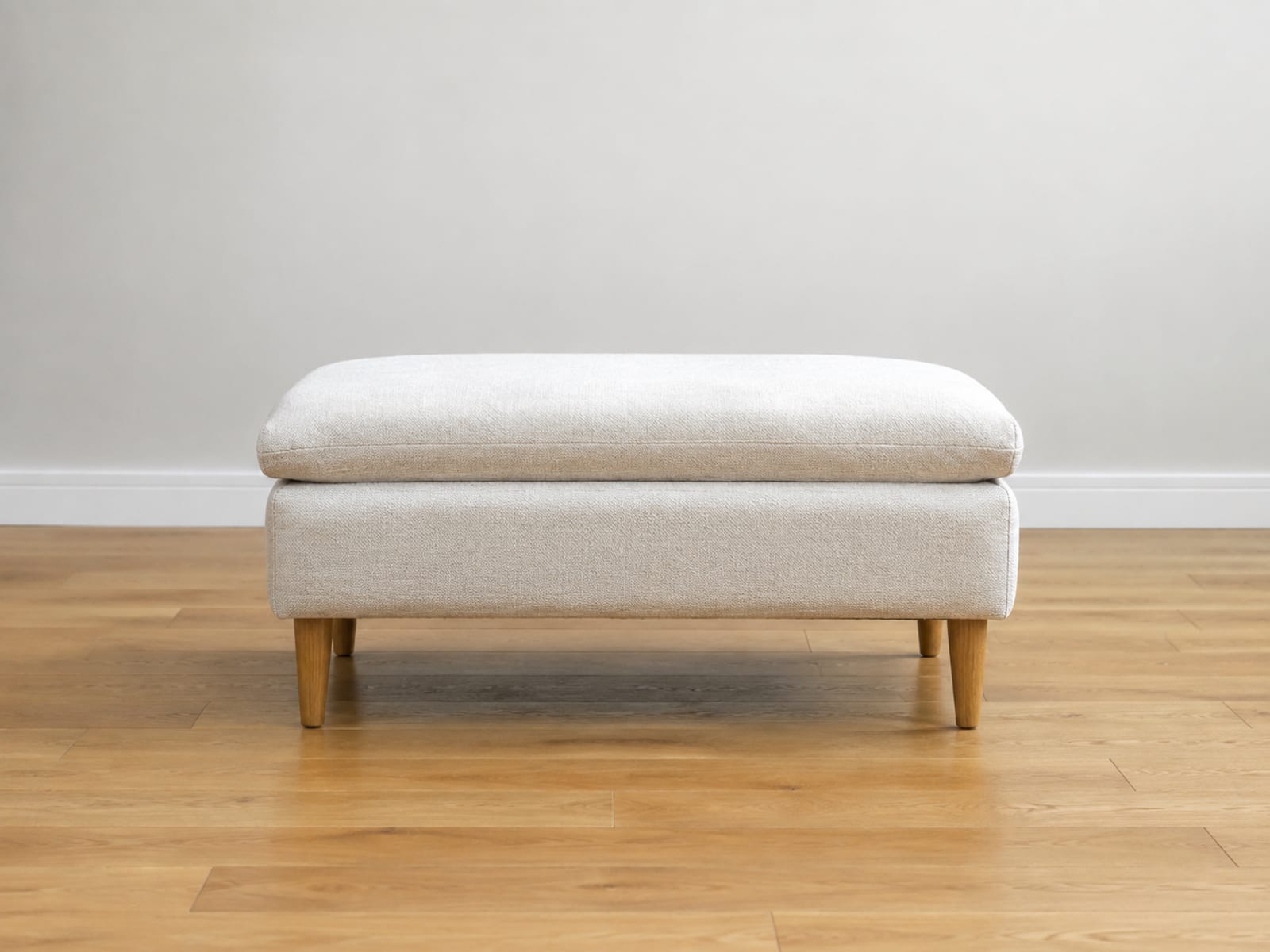
Because your legs are holding themselves up and nothing else is. Seated upright with your feet flat, the weight of your lower legs hangs off the front edge of the seat, and the small shifting that follows is the thing that eventually makes you get up. Supporting the feet takes that away, and it is the difference between finishing a chapter and finishing a book.
Both answers on this page do the same job by different routes. A footrest raises the feet in front of the chair. A very deep seat lets you fold your legs onto the seat itself, which is why the Eos publishes 41 inches and the Penn publishes 20.5. Those are not better and worse chairs. They are two different postures, and the one you actually adopt when nobody is watching is the one to buy for.
The third route is the one worth knowing about for a small room. Apartment Therapy's small-corner recommendation is a chair whose ottoman stows away, at 30 by 26 by 30 inches, so the footrest exists when you are reading and disappears when the room needs its floor back.
How deep is too deep?
Deep enough that your back cannot reach the back is too deep, and that is a matter of your own leg length rather than a number anybody can publish for you. A named poster in an r/backpain thread about armchairs describes needing roughly six inches of padding behind a lumbar roll, because the chair's seat was simply too deep for them. That is one person's own arrangement rather than a general finding, and it is the clearest illustration of why a deep seat is a fit decision rather than an upgrade.
So, the practical test before ordering: sit back until your spine meets the back of the chair, and see where the front edge of the seat falls on your legs. If it is behind your knees, the chair fits. If your knees are still a hand's width from the edge, you will be putting a cushion there for the life of the chair. Where the seat depth is published, as it is for the Penn and the Eos, you can do most of that arithmetic on a kitchen chair and a tape measure before anything is delivered.
Good Housekeeping's reviewer Alyssa Gautieri lands in the same place from a different direction, naming comfort, sturdiness and back support as the things that matter rather than any single chair type. There is no category of furniture called the comfortable one.
Would you get this one right?
1. A chair publishes a 20.5-inch seat depth. What is it for?
2. Two listings, $299 and $499. What might not be comparable?
3. Which published figure tells you whether the chair gets through the door?
4. A cover is described as non-removable. What follows?
Pick an answer to begin.
Frequently asked questions
What type of chair is most comfortable for reading?
No standard defines one, and the type name matters less than whether your feet are supported. A high back chair with a footstool and a very deep swivel chair are both good answers, and they suit different people, because one has you sitting back and the other has you folded onto the seat. Decide which of those you actually do, then shop within it.
What chair is best for sitting long hours?
One that takes the weight of your lower legs off the front edge of the seat, either with a footrest or with enough seat depth to pull your feet up. After that, back support and a seat depth that matches your legs do most of the remaining work. An hour in a chair exposes a fit problem that ten minutes in a showroom will not.
What is the best material for a reading chair?
Whichever one publishes what you need to know about cleaning it, because a reading chair collects coffee and dog hair like any other seat. Read the cover terms specifically: IKEA states the STRANDMON's cover is not removable and its cushion cover is not washable, which is a very different life from a chair whose covers come off. What each cover actually publishes about wear and cleaning applies to a chair the same way it applies to a sofa.
Do I really need the ottoman?
If the chair is for a long read, then either the ottoman or a seat deep enough to replace it, yes. It is also the cheapest part of the decision to get wrong, so buying the chair and its matching footstool together, as IKEA sells the POÄNG, avoids the height mismatch that makes a mixed pair uncomfortable.
The words on a chair listing
Tap a term to see what it means.
Diagonal depth. The measurement across the chair's corner, and the one that has to clear a doorway. West Elm publishes 29 inches for the Penn Chair; most sellers publish nothing.
Decide where your feet are going, and the rest of the shortlist collapses to two or three chairs with published figures you can check against your own room. PlushPick keeps those figures for chairs and sofas in one place, so the next reading corner starts with measurements rather than another photograph.
Cal Hewitt
Writer at PlushPick. I compare sofa specs, comfort, durability, and value so you can buy with clearer expectations.
About Cal and how the guides are researchedRelated
All guides- "Best-of"
Best Furniture Protectors for Pets, by What They Actually Cover
A cover marked waterproof still leaves an exposed arm bare. The best furniture protectors for pets, sorted by what they cover and what they stop.

- "Best-of"
Best Pet-Friendly Sofa Fabrics: Claws, Hair and Spills
Worried your dog or cat will ruin a new couch? Find the best pet-friendly sofa by fabric: claw resistance, hair pickup, stains and removable covers.

- "Best-of"
Best Sofas for Small Spaces: Narrow Doesn't Mean Shallow
Best sofas for small spaces, compared by outside width and seat depth together, because a narrower sofa can have a deeper seat than a wider one.

- "Best-of"
Best Recliner Covers for Dogs: What Actually Stays On
A recliner moves, so a sofa cover will not stay put. The best recliner covers for dogs, sorted by measured seat width, from one chair to a three-seat sofa.
